


Signature operator
In mathematics, the signature operator is an elliptic differential operator defined on a certain subspace of the space of differential forms on an even-dimensional compact Riemannian manifold, whose analytic index is the same as the topological signature of the manifold if the dimension of the manifold is a multiple of four.[1] It is an instance of a Dirac-type operator.
Definition in the even-dimensional case
[edit]Let be a compact Riemannian manifold of even dimension . Let



be the exterior derivative on -th order differential forms on . The Riemannian metric on allows us to define the Hodge star operator and with it the inner product


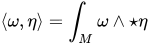
on forms. Denote by

the adjoint operator of the exterior differential . This operator can be expressed purely in terms of the Hodge star operator as follows:


Now consider acting on the space of all forms . One way to consider this as a graded operator is the following: Let be an involution on the space of all forms defined by:

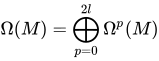


It is verified that anti-commutes with and, consequently, switches the -eigenspaces of


Consequently,
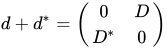
Definition: The operator with the above grading respectively the above operator is called the signature operator of .[1]

Definition in the odd-dimensional case
[edit]In the odd-dimensional case one defines the signature operator to be acting on the even-dimensional forms of .

Hirzebruch Signature Theorem
[edit]If , so that the dimension of is a multiple of four, then Hodge theory implies that:


where the right hand side is the topological signature (i.e. the signature of a quadratic form on defined by the cup product).

The Heat Equation approach to the Atiyah-Singer index theorem can then be used to show that:
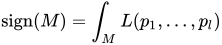
where is the Hirzebruch L-Polynomial,[2] and the the Pontrjagin forms on .[3]


Homotopy invariance of the higher indices
[edit]Kaminker and Miller proved that the higher indices of the signature operator are homotopy-invariant.[4]
See also
[edit]Notes
[edit]References
[edit]- Atiyah, M. F.; Bott, R. (1967), "A Lefschetz fixed-point formula for elliptic complexes I", Annals of Mathematics, 86 (2): 374–407, doi:10.2307/1970694, JSTOR 1970694
- Atiyah, M. F.; Bott, R.; Patodi, V.K. (1973), "On the heat equation and the index theorem", Inventiones Mathematicae, 19 (4): 279–330, Bibcode:1973InMat..19..279A, doi:10.1007/bf01425417, S2CID 115700319
- Gilkey, Peter B. (1973), "Curvature and the eigenvalues of the Laplacian for elliptic complexes", Advances in Mathematics, 10 (3): 344–382, doi:10.1016/0001-8708(73)90119-9
- Hirzebruch, Friedrich (1995), Topological Methods in Algebraic Geometry, 4th edition, Berlin and Heidelberg: Springer-Verlag. Pp. 234, ISBN 978-3-540-58663-0
- Kaminker, Jerome; Miller, John G. (1985), "Homotopy Invariance of the Analytic Index of Signature Operators over C*-Algebras" (PDF), Journal of Operator Theory, 14: 113–127