


Shimizu L-function
 | This article needs more citations. (November 2025) |
In mathematics, the Shimizu L-function, introduced by Hideo Shimizu in 1963,[1] is a Dirichlet series associated to a totally real algebraic number field. Michael Francis Atiyah, H. Donnelly, and I. M. Singer (1983)[2] defined the signature defect of the boundary of a manifold as the eta invariant, the value as s=0 of their eta function, and used this to show that Hirzebruch's signature defect of a cusp of a Hilbert modular surface can be expressed in terms of the value at s=0 or 1 of a Shimizu L-function.
Definition
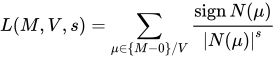
[edit]Suppose that K is a totally real algebraic number field, M is a lattice in the field, and V is a subgroup of maximal rank of the group of totally positive units preserving the lattice. The Shimizu L-series is given by
References
[edit]- ↑ Shimizu, Hideo (January 1963). "On Discontinuous Groups Operating on the Product of the Upper Half Planes". The Annals of Mathematics. 77 (1): 33. doi:10.2307/1970201.
- ↑ Atiyah, Michael Francis; Donnelly, H.; Singer, I. M. (1983), "Eta invariants, signature defects of cusps, and values of L-functions", Annals of Mathematics, Second Series, 118 (1): 131–177, doi:10.2307/2006957, ISSN 0003-486X, JSTOR 2006957, MR 0707164
Further reading
[edit]- Atiyah, Michael Francis; Donnelly, H.; Singer, I. M. (1982), "Geometry and analysis of Shimizu L-functions", Proceedings of the National Academy of Sciences of the United States of America, 79 (18): 5751, Bibcode:1982PNAS...79.5751A, doi:10.1073/pnas.79.18.5751, ISSN 0027-8424, JSTOR 12685, MR 0674920, PMC 346984, PMID 16593231
 | This number theory–related article is a stub. You can help Wikipedia by adding missing information. |