


Run of a sequence
 | This article includes a list of general references but lacks sufficient corresponding inline citations. (June 2021) |
 | This article needs more citations. (April 2021) |
In computer science, a run of a sequence is a non-decreasing range of the sequence that cannot be extended. The number of runs of a sequence is the number of increasing subsequences of the sequence. This is a measure of presortedness, and in particular measures how many subsequences must be merged to sort a sequence.
Definition
[edit]Let be a sequence of elements from a totally ordered set. A run of is a maximal increasing sequence . That is, and [clarification needed] assuming that and exists. For example, if is a natural number, the sequence has the two runs and .








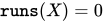
Let be defined as the number of positions such that and . It is equivalently defined as the number of runs of minus one. This definition ensure that , that is, the if, and only if, the sequence is sorted. As another example, and .





Sorting sequences with a low number of runs
[edit]The function is a measure of presortedness. The natural merge sort is -optimal. That is, if it is known that a sequence has a low number of runs, it can be efficiently sorted using the natural merge sort.

Long runs
[edit]A long run is defined similarly to a run, except that the sequence can be either non-decreasing or non-increasing. The number of long runs is not a measure of presortedness. A sequence with a small number of long runs can be sorted efficiently by first reversing the decreasing runs and then using a natural merge sort.
References
[edit]- Powers, David M. W.; McMahon, Graham B. (1983). "A compendium of interesting prolog programs". DCS Technical Report 8313 (Report). Department of Computer Science, University of New South Wales.
- Mannila, H (1985). "Measures of Presortedness and Optimal Sorting Algorithms". IEEE Trans. Comput. (C-34): 318–325. doi:10.1109/TC.1985.5009382.