


Riesz potential
In mathematics, the Riesz potential is a potential named after its discoverer, the Hungarian mathematician Marcel Riesz. In a sense, the Riesz potential defines a fractional inverse power of the Laplace operator on Euclidean space. It generalizes to several variables the Riemann–Liouville integrals of one variable.

Definition
[edit]If 0 < α < n, then the Riesz potential Iαf of a locally integrable function f on Rn is the function defined by
| 1 |
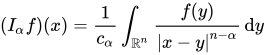
where the constant is given by
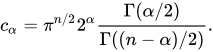
This singular integral is well-defined provided f decays sufficiently rapidly at infinity, specifically if f ∈ Lp(Rn) with 1 ≤ p < n/α. The classical result due to Sobolev states that the rate of decay of f and that of Iαf are related in the form of an inequality (the Hardy–Littlewood–Sobolev inequality)

For p=1 the result was extended by (Schikorra, Spector & Van Schaftingen 2014),

where is the vector-valued Riesz transform. More generally, the operators Iα are well-defined for complex α such that 0 < Re α < n.

The Riesz potential can be defined more generally in a weak sense as the convolution

where Kα is the locally integrable function:
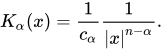
The Riesz potential can therefore be defined whenever f is a compactly supported distribution. In this connection, the Riesz potential of a positive Borel measure μ with compact support is chiefly of interest in potential theory because Iαμ is then a (continuous) subharmonic function off the support of μ, and is lower semicontinuous on all of Rn.
Consideration of the Fourier transform reveals that the Riesz potential is a Fourier multiplier.[1] In fact, one has

and so, by the convolution theorem,

The Riesz potentials satisfy the following semigroup property on, for instance, rapidly decreasing continuous functions

provided

Furthermore, if 0 < Re α < n–2, then

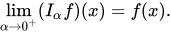
One also has, for this class of functions,
See also
[edit]Notes
[edit]- ↑ Samko 1998, section II.
References
[edit]- Landkof, N. S. (1972), Foundations of modern potential theory, Berlin, New York: Springer-Verlag, MR 0350027
- Riesz, Marcel (1949), "L'intégrale de Riemann-Liouville et le problème de Cauchy", Acta Mathematica, 81: 1–223, doi:10.1007/BF02395016, ISSN 0001-5962, MR 0030102.
- Solomentsev, E.D. (2001) [1994], "Riesz potential", Encyclopedia of Mathematics, EMS Press
- Schikorra, Armin; Spector, Daniel; Van Schaftingen, Jean (2014), An -type estimate for Riesz potentials, arXiv:1411.2318, doi:10.4171/rmi/937, S2CID 55497245
- Stein, Elias (1970), Singular integrals and differentiability properties of functions, Princeton, NJ: Princeton University Press, ISBN 0-691-08079-8
- Samko, Stefan G. (1998), "A new approach to the inversion of the Riesz potential operator" (PDF), Fractional Calculus and Applied Analysis, 1 (3): 225–245, archived from the original (PDF) on 2016-02-22, retrieved 2018-03-22
