


Restricted sumset
In additive number theory and combinatorics, a restricted sumset has the form

where are finite nonempty subsets of a field F and is a polynomial over F.

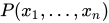
If is a constant non-zero function, for example for any , then is the usual sumset which is denoted by if







When

S is written as which is denoted by if


Note that |S| > 0 if and only if there exist with


Cauchy–Davenport theorem
[edit]The Cauchy–Davenport theorem, named after Augustin Louis Cauchy and Harold Davenport, asserts that for any prime p and nonempty subsets A and B of the prime-order cyclic group we have the inequality[1][2][3]


where , i.e. using modular arithmetic. It can be generalised to arbitrary (not necessarily abelian) groups using a Dyson transform. If are subsets of a group , then[4]



where is the size of the smallest nontrivial subgroup of (we set it to if there is no such subgroup).


This can be used to deduce the Erdős–Ginzburg–Ziv theorem: given any sequence of 2n−1 elements in the cyclic group , there are n elements that sum to zero modulo n. (Here n does not need to be prime.)[5][6]

A direct consequence of the Cauchy-Davenport theorem is: Given any sequence S of p−1 or more nonzero elements, not necessarily distinct, of , every element of can be written as the sum of the elements of some subsequence (possibly empty) of S.[7]
Kneser's theorem generalises this to general abelian groups.[8]
Erdős–Heilbronn conjecture
[edit]The Erdős–Heilbronn conjecture posed by Paul Erdős and Hans Heilbronn in 1964 states that if p is a prime and A is a nonempty subset of the field Z/pZ.[9] This was first confirmed by J. A. Dias da Silva and Y. O. Hamidoune in 1994[10] who showed that


where A is a finite nonempty subset of a field F, and p(F) is a prime p if F is of characteristic p, and p(F) = ∞ if F is of characteristic 0. Various extensions of this result were given by Noga Alon, M. B. Nathanson and I. Ruzsa in 1996,[11] Q. H. Hou and Zhi-Wei Sun in 2002,[12] and G. Karolyi in 2004.[13]
Combinatorial Nullstellensatz
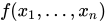
[edit]A tool in the study of lower bounds for cardinalities of various restricted sumsets is the following principle: the combinatorial Nullstellensatz.[14] Let be a polynomial over a field . Suppose that the coefficient of the monomial in is nonzero and is the total degree of . If are finite subsets of with for , then there are such that .





This result was rooted in a paper of N. Alon and M. Tarsi in 1989,[15] and developed by Alon, Nathanson and Ruzsa in 1995–1996,[11] and reformulated by Alon in 1999.[14]
See also
[edit]References
[edit]- ↑ Nathanson (1996) p.44
- ↑ Geroldinger & Ruzsa (2009) pp.141–142
- ↑ Jeffrey Paul Wheeler (2012). "The Cauchy-Davenport Theorem for Finite Groups". arXiv:1202.1816 [math.CO].
- ↑ DeVos, Matt (2016). "On a Generalization of the Cauchy-Davenport Theorem". Integers. 16.
- ↑ Nathanson (1996) p.48
- ↑ Geroldinger & Ruzsa (2009) p.53
- ↑ Wolfram's MathWorld, Cauchy-Davenport Theorem, http://mathworld.wolfram.com/Cauchy-DavenportTheorem.html, accessed 20 June 2012.
- ↑ Geroldinger & Ruzsa (2009) p.143
- ↑ Nathanson (1996) p.77
- ↑ Dias da Silva, J. A.; Hamidoune, Y. O. (1994). "Cyclic spaces for Grassmann derivatives and additive theory". Bulletin of the London Mathematical Society. 26 (2): 140–146. doi:10.1112/blms/26.2.140.
- 1 2 Alon, Noga; Nathanson, Melvyn B.; Ruzsa, Imre (1996). "The polynomial method and restricted sums of congruence classes" (PDF). Journal of Number Theory. 56 (2): 404–417. doi:10.1006/jnth.1996.0029. MR 1373563.
- ↑ Hou, Qing-Hu; Sun, Zhi-Wei (2002). "Restricted sums in a field". Acta Arithmetica. 102 (3): 239–249. Bibcode:2002AcAri.102..239H. doi:10.4064/aa102-3-3. MR 1884717.
- ↑ Károlyi, Gyula (2004). "The Erdős–Heilbronn problem in abelian groups". Israel Journal of Mathematics. 139: 349–359. doi:10.1007/BF02787556. MR 2041798. S2CID 33387005.
- 1 2 Alon, Noga (1999). "Combinatorial Nullstellensatz" (PDF). Combinatorics, Probability and Computing. 8 (1–2): 7–29. doi:10.1017/S0963548398003411. MR 1684621. S2CID 209877602.
- ↑ Alon, Noga; Tarsi, Michael (1989). "A nowhere-zero point in linear mappings". Combinatorica. 9 (4): 393–395. CiteSeerX 10.1.1.163.2348. doi:10.1007/BF02125351. MR 1054015. S2CID 8208350.
{{cite journal}}: Cite uses deprecated parameter|citeseerx=(help)
- Geroldinger, Alfred; Ruzsa, Imre Z., eds. (2009). Combinatorial number theory and additive group theory. Advanced Courses in Mathematics CRM Barcelona. Elsholtz, C.; Freiman, G.; Hamidoune, Y. O.; Hegyvári, N.; Károlyi, G.; Nathanson, M.; Solymosi, J.; Stanchescu, Y. With a foreword by Javier Cilleruelo, Marc Noy and Oriol Serra (Coordinators of the DocCourse). Basel: Birkhäuser. ISBN 978-3-7643-8961-1. Zbl 1177.11005.
- Nathanson, Melvyn B. (1996). Additive Number Theory: Inverse Problems and the Geometry of Sumsets. Graduate Texts in Mathematics. Vol. 165. Springer-Verlag. ISBN 0-387-94655-1. Zbl 0859.11003.