


Resolvent set
In linear algebra and operator theory, the resolvent set of a linear operator is a set of complex numbers for which the operator is in some sense "well-behaved". The resolvent set plays an important role in the resolvent formalism.
Definitions
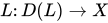
[edit]Let X be a Banach space and let be a linear operator with domain . Let id denote the identity operator on X. For any , let



A complex number is said to be a regular value if the following three statements are true:

- is injective, that is, the corestriction of to its image has an inverse called the resolvent;[1]
- is a bounded linear operator;
- is defined on a dense subspace of X, that is, has dense range.



The resolvent set of L is the set of all regular values of L:

The spectrum is the complement of the resolvent set

and subject to a mutually singular spectral decomposition into the point spectrum (when condition 1 fails), the continuous spectrum (when condition 2 fails) and the residual spectrum (when condition 3 fails).
If is a closed operator, then so is each , and condition 3 may be replaced by requiring that be surjective.

Properties
[edit]- The resolvent set of a bounded linear operator L is an open set.
- More generally, the resolvent set of a densely defined closed unbounded operator is an open set.

Notes
[edit]- ↑ Reed & Simon 1980, p. 188.
References
[edit]- Reed, M.; Simon, B. (1980). Methods of Modern Mathematical Physics: Vol 1: Functional analysis. Academic Press. ISBN 978-0-12-585050-6.
- Renardy, Michael; Rogers, Robert C. (2004). An introduction to partial differential equations. Texts in Applied Mathematics 13 (Second ed.). New York: Springer-Verlag. xiv+434. ISBN 0-387-00444-0. MR 2028503 (See section 8.3)
External links
[edit]- Voitsekhovskii, M.I. (2001) [1994], "Resolvent set", Encyclopedia of Mathematics, EMS Press