


Rees factor semigroup
In mathematics, in semigroup theory, a Rees factor semigroup (also called Rees quotient semigroup or just Rees factor), named after David Rees, is a certain semigroup constructed using a semigroup and an ideal of the semigroup.
Let S be a semigroup and I be an ideal of S. Using S and I one can construct a new semigroup by collapsing I into a single element while the elements of S outside of I retain their identity. The new semigroup obtained in this way is called the Rees factor semigroup of S modulo I and is denoted by S/I.
The concept of Rees factor semigroup was introduced by David Rees in 1940.[1][2]
Formal definition
[edit]A subset of a semigroup is called an ideal of if both and are subsets of (where , and similarly for ). Let be an ideal of a semigroup . The relation in defined by




- x ρ y ⇔ either x = y or both x and y are in I
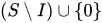
is an equivalence relation in . The equivalence classes under are the singleton sets with not in and the set . Since is an ideal of , the relation is a congruence on .[3] The quotient semigroup is, by definition, the Rees factor semigroup of modulo . For notational convenience the semigroup is also denoted as . The Rees factor semigroup[4] has underlying set , where is a new element and the product (here denoted by ) is defined by




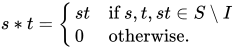
The congruence on as defined above is called the Rees congruence on modulo .
Example
[edit]Consider the semigroup S = { a, b, c, d, e } with the binary operation defined by the following Cayley table:
| · | a | b | c | d | e |
|---|---|---|---|---|---|
| a | a | a | a | d | d |
| b | a | b | c | d | d |
| c | a | c | b | d | d |
| d | d | d | d | a | a |
| e | d | e | e | a | a |
Let I = { a, d } which is a subset of S. Since
- SI = { aa, ba, ca, da, ea, ad, bd, cd, dd, ed } = { a, d } ⊆ I
- IS = { aa, da, ab, db, ac, dc, ad, dd, ae, de } = { a, d } ⊆ I
the set I is an ideal of S. The Rees factor semigroup of S modulo I is the set S/I = { b, c, e, I } with the binary operation defined by the following Cayley table:
| · | b | c | e | I |
|---|---|---|---|---|
| b | b | c | I | I |
| c | c | b | I | I |
| e | e | e | I | I |
| I | I | I | I | I |
Ideal extension
[edit]A semigroup S is called an ideal extension of a semigroup A by a semigroup B if A is an ideal of S and the Rees factor semigroup S/A is isomorphic to B. [5]
Some of the cases that have been studied extensively include: ideal extensions of completely simple semigroups, of a group by a completely 0-simple semigroup, of a commutative semigroup with cancellation by a group with added zero. In general, the problem of describing all ideal extensions of a semigroup is still open.[6]
References
[edit]- ↑ Rees, D. (1940). "On semigroups". Mathematical Proceedings of the Cambridge Philosophical Society. 36 (4): 387–400. doi:10.1017/S0305004100017436. S2CID 123038112. MR 2, 127
- ↑ Clifford, Alfred Hoblitzelle; Preston, Gordon Bamford (1961). The algebraic theory of semigroups. Vol. I. Mathematical Surveys, No. 7. Providence, R.I.: American Mathematical Society. ISBN 978-0-8218-0272-4. MR 0132791.
{{cite book}}: ISBN / Date incompatibility (help) - ↑ Lawson (1998) Inverse Semigroups: the theory of partial symmetries, page 60, World Scientific with Google Books link
- ↑ Howie, John M. (1995), Fundamentals of Semigroup Theory, Clarendon Press, ISBN 0-19-851194-9
- ↑ Mikhalev, Aleksandr Vasilʹevich; Pilz, Günter (2002). The concise handbook of algebra. Springer. ISBN 978-0-7923-7072-7.(pp. 1–3)
- ↑ Gluskin, L.M. (2001) [1994], "Extension of a semi-group", Encyclopedia of Mathematics, EMS Press
- Lawson, M.V. (1998). Inverse semigroups: the theory of partial symmetries. World Scientific. ISBN 978-981-02-3316-7.
This article incorporates material from Rees factor on PlanetMath, which is licensed under the Creative Commons Attribution/Share-Alike License.