


Rank mobility index
In demographics, the rank mobility index (RMI) is a measure of a city's change in population rank among a group of cities.[1][2]
Formally
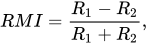
where
- R1 = city's rank at time 1
- R2 = city's rank at time 2
A RMI value must be between −1 and 1. A RMI of 0 indicates no change.[3][4]
References
[edit]- ↑ D'Agostino, Marcello; Dardanoni, Valentino (2009-07-01). "The measurement of rank mobility". Journal of Economic Theory. 144 (4): 1783–1803. doi:10.1016/j.jet.2008.11.003. ISSN 0022-0531.
- ↑ Sheng, Kerong; Fan, Jie; Sun, Wei; Ma, Hailong (2016-06-01). "From sequential to parallel growth of cities: Theory and evidence from Canada". Chinese Geographical Science. 26 (3): 377–388. doi:10.1007/s11769-015-0750-5. ISSN 1993-064X.
- ↑ Greene, Richard P.; Pick, James B. (2006). Exploring the Urban Community: A GIS Approach. Pearson Prentice Hall. ISBN 978-0-13-017576-2.
- ↑ Greene, Richard P.; Pick, James B. (2013-06-01). "Shifting patterns of suburban dominance: the case of Chicago from 2000 to 2010". Journal of Maps. 9 (2): 178–182. doi:10.1080/17445647.2013.782257.
 | This statistics-related article is a stub. You can help Wikipedia by adding missing information. |