


q-exponential
The term q-exponential occurs in two contexts. The q-exponential distribution, based on the Tsallis q-exponential is discussed in elsewhere.
In combinatorial mathematics, a q-exponential is a q-analog of the exponential function, namely the eigenfunction of a q-derivative. There are many q-derivatives, for example, the classical q-derivative, the Askey–Wilson operator, etc. Therefore, unlike the classical exponentials, q-exponentials are not unique. For example, is the q-exponential corresponding to the classical q-derivative while are eigenfunctions of the Askey–Wilson operators.


The q-exponential is also known as the quantum dilogarithm.[1][2]
Definition
[edit]The q-exponential is defined as
![{\displaystyle e_{q}(z)=\sum _{n=0}^{\infty }{\frac {z^{n}}{[n]!_{q}}}=\sum _{n=0}^{\infty }{\frac {z^{n}(1-q)^{n}}{(q;q)_{n}}}=\sum _{n=0}^{\infty }z^{n}{\frac {(1-q)^{n}}{(1-q^{n})(1-q^{n-1})\cdots (1-q)}}}](https://wikimedia.org/api/rest_v1/media/math/render/svg/1df0494e3aee34b37279c904f912f2d4f81dc311)
where is the q-factorial and
![{\displaystyle [n]!_{q}}](https://wikimedia.org/api/rest_v1/media/math/render/svg/b9908fef01f897a1326dac11c8c37a95c82e2c5f)

is the q-Pochhammer symbol. That this is the q-analog of the exponential follows from the property
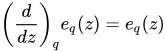
where the derivative on the left is the q-derivative. The above is easily verified by considering the q-derivative of the monomial
![{\displaystyle \left({\frac {d}{dz}}\right)_{q}z^{n}=z^{n-1}{\frac {1-q^{n}}{1-q}}=[n]_{q}z^{n-1}.}](https://wikimedia.org/api/rest_v1/media/math/render/svg/c5454c7904c36ab46a23fd93c086675aa4f7f618)
Here, is the q-bracket. For other definitions of the q-exponential function, see Exton (1983), Ismail & Zhang (1994), and Cieśliński (2011).
![{\displaystyle [n]_{q}}](https://wikimedia.org/api/rest_v1/media/math/render/svg/3dfd22063139d4a06ae9dfcaf79a85a2b2f751fc)
Properties
[edit]For real , the function is an entire function of . For , is regular in the disk .



Note the inverse, .

Addition Formula
[edit]The analogue of does not hold for real numbers and . However, if these are operators satisfying the commutation relation , then holds true.[3]




Relations
[edit]For , a function that is closely related is It is a special case of the basic hypergeometric series,



Clearly,

Relation with Dilogarithm
[edit]has the following infinite product representation:

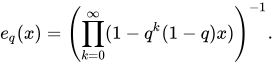
On the other hand, holds. When ,
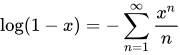

![{\displaystyle {\begin{aligned}\log e_{q}(x)&=-\sum _{k=0}^{\infty }\log(1-q^{k}(1-q)x)\\&=\sum _{k=0}^{\infty }\sum _{n=1}^{\infty }{\frac {(q^{k}(1-q)x)^{n}}{n}}\\&=\sum _{n=1}^{\infty }{\frac {((1-q)x)^{n}}{(1-q^{n})n}}\\&={\frac {1}{1-q}}\sum _{n=1}^{\infty }{\frac {((1-q)x)^{n}}{[n]_{q}n}}\end{aligned}}.}](https://wikimedia.org/api/rest_v1/media/math/render/svg/adeebd93d418e5c68eada4e8607dcf515f21a37f)
By taking the limit ,


where is the dilogarithm.

References
[edit]- ↑ Zudilin, Wadim (14 March 2006). "Quantum dilogarithm" (PDF). wain.mi.ras.ru. Archived from the original (PDF) on 5 July 2017. Retrieved 16 July 2021.
- ↑ Faddeev, L.d.; Kashaev, R.m. (1994-02-20). "Quantum dilogarithm". Modern Physics Letters A. 09 (5): 427–434. arXiv:hep-th/9310070. Bibcode:1994MPLA....9..427F. doi:10.1142/S0217732394000447. ISSN 0217-7323. S2CID 119124642.
- ↑ Kac, V.; Cheung, P. (2011). Quantum Calculus. Springer. p. 31. ISBN 978-1461300724.
- Cieśliński, Jan L. (2011). "Improved q-exponential and q-trigonometric functions". Applied Mathematics Letters. 24 (12): 2110–2114. arXiv:1006.5652. doi:10.1016/j.aml.2011.06.009. S2CID 205496812.
- Exton, Harold (1983). q-Hypergeometric Functions and Applications. New York: Halstead Press, Chichester: Ellis Horwood. ISBN 0853124914.
- Gasper, George; Rahman, Mizan Rahman (2004). Basic Hypergeometric Series. Cambridge University Press. ISBN 0521833574.
- Ismail, Mourad E. H. (2005). Classical and Quantum Orthogonal Polynomials in One Variable. Cambridge University Press. doi:10.1017/CBO9781107325982. ISBN 9780521782012.
- Ismail, Mourad E. H.; Zhang, Ruiming (1994). "Diagonalization of certain integral operators". Advances in Mathematics. 108 (1): 1–33. doi:10.1006/aima.1994.1077.
- Ismail, Mourad E. H.; Rahman, Mizan; Zhang, Ruiming (1996). "Diagonalization of certain integral operators II". Journal of Computational and Applied Mathematics. 68 (1–2): 163–196. CiteSeerX 10.1.1.234.4251. doi:10.1016/0377-0427(95)00263-4.
{{cite journal}}: Cite uses deprecated parameter|citeseerx=(help) - Jackson, F. H. (1909). "On q-functions and a certain difference operator". Transactions of the Royal Society of Edinburgh. 46 (2): 253–281. doi:10.1017/S0080456800002751. S2CID 123927312.