


Probalign
Probalign is a sequence alignment tool that calculates a maximum expected accuracy alignment using partition function posterior probabilities.[1] Base pair probabilities are estimated using an estimate similar to the Boltzmann distribution. The partition function is calculated using a dynamic programming approach.
Algorithm
[edit]The following describes the algorithm used by probalign to determine the base pair probabilities.[2]
Alignment score
[edit]To score an alignment of two sequences two things are needed:
- a similarity function (e.g. PAM, BLOSUM,...)
- affine gap penalty:

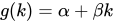
The score of an alignment a is defined as:


Now the boltzmann weighted score of an alignment a is:

Where is a scaling factor.

The probability of an alignment assuming boltzmann distribution is given by
![{\displaystyle Pr[a|x,y]={\frac {e^{\frac {S(a)}{T}}}{Z}}}](https://wikimedia.org/api/rest_v1/media/math/render/svg/bc95755b68056106788d9ba71ad9e9bc5be6fafb)
Where is the partition function, i.e. the sum of the boltzmann weights of all alignments.

Dynamic programming
[edit]Let denote the partition function of the prefixes and . Three different cases are considered:



- the partition function of all alignments of the two prefixes that end in a match.
- the partition function of all alignments of the two prefixes that end in an insertion .
- the partition function of all alignments of the two prefixes that end in a deletion .


Then we have:

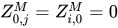
Initialization
[edit]The matrixes are initialized as follows:


Recursion
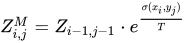
[edit]The partition function for the alignments of two sequences and is given by , which can be recursively computed:


- analogously


Base pair probability
[edit]Finally the probability that positions and form a base pair is given by:


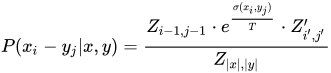
are the respective values for the recalculated with inversed base pair strings.

See also
[edit]References
[edit]- ↑ U. Roshan and D. R. Livesay, Probalign: multiple sequence alignment using partition function posterior probabilities, Bioinformatics, 22(22):2715-21, 2006 (PDF)
- ↑ Lecture "Bioinformatics II" at University of Freiburg