


Principal root of unity
 | This article relies on a single source. (May 2024) |
In mathematics, a principal n-th root of unity (where n is a positive integer) of a ring is an element satisfying the equations

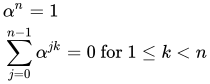
In an integral domain, every primitive n-th root of unity is also a principal -th root of unity. In any ring, if n is a power of 2, then any n/2-th root of −1 is a principal n-th root of unity.

A non-example is in the ring of integers modulo ; while and thus is a cube root of unity, meaning that it is not a principal cube root of unity.




The significance of a root of unity being principal is that it is a necessary condition for the theory of the discrete Fourier transform to work out correctly.
References
[edit]- Bini, D.; Pan, V. (1994), Polynomial and Matrix Computations, vol. 1, Boston, MA: Birkhäuser, p. 11
 | This polynomial-related article is a stub. You can help Wikipedia by adding missing information. |