Properties and relations [ edit ] The function
ω
(
n
)
{\displaystyle \omega (n)}
additive and
Ω
(
n
)
{\displaystyle \Omega (n)}
completely additive . Little omega has the formula
ω
(
n
)
=
∑
p
∣
n
1
,
{\displaystyle \omega (n)=\sum _{p\mid n}1,}
where notation p |n p that divide n , without multiplicity. For example,
ω
(
12
)
=
ω
(
2
2
3
)
=
2
{\displaystyle \omega (12)=\omega (2^{2}3)=2}
Big omega has the formulas
Ω
(
n
)
=
∑
p
α
∣
n
1
=
∑
p
α
∥
n
α
.
{\displaystyle \Omega (n)=\sum _{p^{\alpha }\mid n}1=\sum _{p^{\alpha }\parallel n}\alpha .}
The notation p α n p α n , while p α n p α n and such that n / p α p α
Ω
(
12
)
=
Ω
(
2
2
3
1
)
=
3
{\displaystyle \Omega (12)=\Omega (2^{2}3^{1})=3}
The omegas are related by the inequalities ω n ) ≤ Ω (n )2ω n )≤ d (n ) ≤ 2Ω (n ) , where d (n )divisor-counting function .[ 1] Ω (n ) = ω n )n is squarefree and related to the Möbius function by
μ
(
n
)
=
(
−
1
)
ω
(
n
)
=
(
−
1
)
Ω
(
n
)
.
{\displaystyle \mu (n)=(-1)^{\omega (n)}=(-1)^{\Omega (n)}.}
If
ω
(
n
)
=
1
{\displaystyle \omega (n)=1}
n
{\displaystyle n}
prime power , and if
Ω
(
n
)
=
1
{\displaystyle \Omega (n)=1}
n
{\displaystyle n}
An asymptotic series for the average order of
ω
(
n
)
{\displaystyle \omega (n)}
[ 2]
1
n
∑
k
=
1
n
ω
(
k
)
∼
log
log
n
+
B
1
+
∑
k
≥
1
(
∑
j
=
0
k
−
1
γ
j
j
!
−
1
)
(
k
−
1
)
!
(
log
n
)
k
,
{\displaystyle {\frac {1}{n}}\sum \limits _{k=1}^{n}\omega (k)\sim \log \log n+B_{1}+\sum _{k\geq 1}\left(\sum _{j=0}^{k-1}{\frac {\gamma _{j}}{j!}}-1\right){\frac {(k-1)!}{(\log n)^{k}}},}
where
B
1
≈
0.26149721
{\displaystyle B_{1}\approx 0.26149721}
Mertens constant and
γ
j
{\displaystyle \gamma _{j}}
Stieltjes constants .
The function
ω
(
n
)
{\displaystyle \omega (n)}
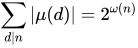
Möbius function and the divisor function , including:[ 3]
∑
d
∣
n
|
μ
(
d
)
|
=
2
ω
(
n
)
{\displaystyle \sum _{d\mid n}|\mu (d)|=2^{\omega (n)}}
unitary divisors . (sequence A034444 in the OEIS )
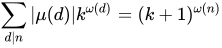
∑
d
∣
n
|
μ
(
d
)
|
k
ω
(
d
)
=
(
k
+
1
)
ω
(
n
)
{\displaystyle \sum _{d\mid n}|\mu (d)|k^{\omega (d)}=(k+1)^{\omega (n)}}
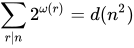
∑
r
∣
n
2
ω
(
r
)
=
d
(
n
2
)
{\displaystyle \sum _{r\mid n}2^{\omega (r)}=d(n^{2})}
∑
r
∣
n
2
ω
(
r
)
d
(
n
r
)
=
d
2
(
n
)
{\displaystyle \sum _{r\mid n}2^{\omega (r)}d\left({\frac {n}{r}}\right)=d^{2}(n)}
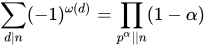
∑
d
∣
n
(
−
1
)
ω
(
d
)
=
∏
p
α
|
|
n
(
1
−
α
)
{\displaystyle \sum _{d\mid n}(-1)^{\omega (d)}=\prod \limits _{p^{\alpha }||n}(1-\alpha )}
∑
(
k
,
m
)
=
1
1
≤
k
≤
m
gcd
(
k
2
−
1
,
m
1
)
gcd
(
k
2
−
1
,
m
2
)
=
φ
(
n
)
∑
d
2
∣
m
2
d
1
∣
m
1
φ
(
gcd
(
d
1
,
d
2
)
)
2
ω
(
lcm
(
d
1
,
d
2
)
)
,
m
1
,
m
2
odd
,
m
=
lcm
(
m
1
,
m
2
)
{\displaystyle \sum _{\stackrel {1\leq k\leq m}{(k,m)=1}}\gcd(k^{2}-1,m_{1})\gcd(k^{2}-1,m_{2})=\varphi (n)\sum _{\stackrel {d_{1}\mid m_{1}}{d_{2}\mid m_{2}}}\varphi (\gcd(d_{1},d_{2}))2^{\omega (\operatorname {lcm} (d_{1},d_{2}))},\ m_{1},m_{2}{\text{ odd}},m=\operatorname {lcm} (m_{1},m_{2})}
∑
gcd
(
k
,
m
)
=
1
1
≤
k
≤
n
1
=
n
φ
(
m
)
m
+
O
(
2
ω
(
m
)
)
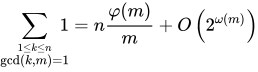
{\displaystyle \sum _{\stackrel {1\leq k\leq n}{\operatorname {gcd} (k,m)=1}}\!\!\!\!1=n{\frac {\varphi (m)}{m}}+O\left(2^{\omega (m)}\right)}
The characteristic function of the primes can be expressed by a convolution with the Möbius function :[ 4]
χ
P
(
n
)
=
(
μ
∗
ω
)
(
n
)
=
∑
d
|
n
ω
(
d
)
μ
(
n
/
d
)
.
{\displaystyle \chi _{\mathbb {P} }(n)=(\mu \ast \omega )(n)=\sum _{d|n}\omega (d)\mu (n/d).}
A partition-related exact identity for
ω
(
n
)
{\displaystyle \omega (n)}
[ 5]
ω
(
n
)
=
log
2
[
∑
k
=
1
n
∑
j
=
1
k
(
∑
d
∣
k
∑
i
=
1
d
p
(
d
−
j
i
)
)
s
n
,
k
⋅
|
μ
(
j
)
|
]
,
{\displaystyle \omega (n)=\log _{2}\left[\sum _{k=1}^{n}\sum _{j=1}^{k}\left(\sum _{d\mid k}\sum _{i=1}^{d}p(d-ji)\right)s_{n,k}\cdot |\mu (j)|\right],}
where
p
(
n
)
{\displaystyle p(n)}
partition function ,
μ
(
n
)
{\displaystyle \mu (n)}
Möbius function , and the triangular sequence
s
n
,
k
{\displaystyle s_{n,k}}
s
n
,
k
=
[
q
n
]
(
q
;
q
)
∞
q
k
1
−
q
k
=
s
o
(
n
,
k
)
−
s
e
(
n
,
k
)
,
{\displaystyle s_{n,k}=[q^{n}](q;q)_{\infty }{\frac {q^{k}}{1-q^{k}}}=s_{o}(n,k)-s_{e}(n,k),}
in terms of the infinite q-Pochhammer symbol and the restricted partition functions
s
o
/
e
(
n
,
k
)
{\displaystyle s_{o/e}(n,k)}
k
{\displaystyle k}
n
{\displaystyle n}
odd (even ) number of distinct parts.[ 6]
Average order and summatory functions [ edit ] An average order of both
ω
(
n
)
{\displaystyle \omega (n)}
Ω
(
n
)
{\displaystyle \Omega (n)}
log
log
n
{\displaystyle \log \log n}
n
{\displaystyle n}
prime a lower bound on the value of the function is
ω
(
n
)
=
1
{\displaystyle \omega (n)=1}
n
{\displaystyle n}
primorial then the function is as large as
ω
(
n
)
∼
log
n
log
log
n
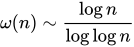
{\displaystyle \omega (n)\sim {\frac {\log n}{\log \log n}}}
on average order. When
n
{\displaystyle n}
power of 2 , then
Ω
(
n
)
=
log
2
(
n
)
.
{\displaystyle \Omega (n)=\log _{2}(n).}
[ 9]
Asymptotics for the summatory functions over
ω
(
n
)
{\displaystyle \omega (n)}
Ω
(
n
)
{\displaystyle \Omega (n)}
ω
(
n
)
{\displaystyle \omega (n)}
[ 10] [ 11]
∑
n
≤
x
ω
(
n
)
=
x
log
log
x
+
B
1
x
+
o
(
x
)
∑
n
≤
x
Ω
(
n
)
=
x
log
log
x
+
B
2
x
+
o
(
x
)
∑
n
≤
x
ω
(
n
)
2
=
x
(
log
log
x
)
2
+
O
(
x
log
log
x
)
∑
n
≤
x
ω
(
n
)
k
=
x
(
log
log
x
)
k
+
O
(
x
(
log
log
x
)
k
−
1
)
,
k
∈
Z
+
,
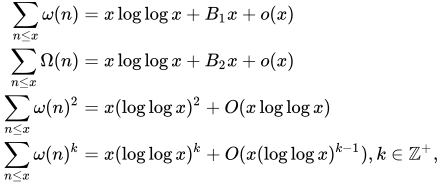
{\displaystyle {\begin{aligned}\sum _{n\leq x}\omega (n)&=x\log \log x+B_{1}x+o(x)\\\sum _{n\leq x}\Omega (n)&=x\log \log x+B_{2}x+o(x)\\\sum _{n\leq x}\omega (n)^{2}&=x(\log \log x)^{2}+O(x\log \log x)\\\sum _{n\leq x}\omega (n)^{k}&=x(\log \log x)^{k}+O(x(\log \log x)^{k-1}),k\in \mathbb {Z} ^{+},\end{aligned}}}
where
B
1
≈
0.2614972128
{\displaystyle B_{1}\approx 0.2614972128}
Mertens constant and the constant
B
2
{\displaystyle B_{2}}
B
2
=
B
1
+
∑
p
prime
1
p
(
p
−
1
)
≈
1.0345061758.
{\displaystyle B_{2}=B_{1}+\sum _{p{\text{ prime}}}{\frac {1}{p(p-1)}}\approx 1.0345061758.}
The sum of number of unitary divisors is
∑
n
≤
x
2
ω
(
n
)
=
(
x
log
x
)
/
ζ
(
2
)
+
O
(
x
)
{\displaystyle \sum _{n\leq x}2^{\omega (n)}=(x\log x)/\zeta (2)+O(x)}
[ 12] (sequence A064608 in the OEIS )
Other sums relating the two variants of the prime omega functions include [ 13]
∑
n
≤
x
{
Ω
(
n
)
−
ω
(
n
)
}
=
O
(
x
)
,
{\displaystyle \sum _{n\leq x}\left\{\Omega (n)-\omega (n)\right\}=O(x),}
and
#
{
n
≤
x
:
Ω
(
n
)
−
ω
(
n
)
>
log
log
x
}
=
O
(
x
(
log
log
x
)
1
/
2
)
.
{\displaystyle \#\left\{n\leq x:\Omega (n)-\omega (n)>{\sqrt {\log \log x}}\right\}=O\left({\frac {x}{(\log \log x)^{1/2}}}\right).}
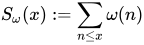
Example I: A modified summatory function [ edit ] In this example we suggest a variant of the summatory functions
S
ω
(
x
)
:=
∑
n
≤
x
ω
(
n
)
{\displaystyle S_{\omega }(x):=\sum _{n\leq x}\omega (n)}
x
{\displaystyle x}
S
ω
(
x
)
{\displaystyle S_{\omega }(x)}
[ 14]
To be completely precise, let the odd-indexed summatory function be defined as
S
odd
(
x
)
:=
∑
n
≤
x
ω
(
n
)
[
n
odd
]
,
{\displaystyle S_{\operatorname {odd} }(x):=\sum _{n\leq x}\omega (n)[n{\text{ odd}}],}
where
[
⋅
]
{\displaystyle [\cdot ]}
Iverson bracket . Then we have that
S
odd
(
x
)
=
x
2
log
log
x
+
(
2
B
1
−
1
)
x
4
+
{
x
4
}
−
[
x
≡
2
,
3
mod
4
]
+
O
(
x
log
x
)
.
{\displaystyle S_{\operatorname {odd} }(x)={\frac {x}{2}}\log \log x+{\frac {(2B_{1}-1)x}{4}}+\left\{{\frac {x}{4}}\right\}-\left[x\equiv 2,3{\bmod {4}}\right]+O\left({\frac {x}{\log x}}\right).}
The proof of this result follows by first observing that
ω
(
2
n
)
=
{
ω
(
n
)
+
1
,
if
n
is odd;
ω
(
n
)
,
if
n
is even,
{\displaystyle \omega (2n)={\begin{cases}\omega (n)+1,&{\text{if }}n{\text{ is odd; }}\\\omega (n),&{\text{if }}n{\text{ is even,}}\end{cases}}}
and then applying the asymptotic result from Hardy and Wright for the summatory function over
ω
(
n
)
{\displaystyle \omega (n)}
S
ω
(
x
)
:=
∑
n
≤
x
ω
(
n
)
{\displaystyle S_{\omega }(x):=\sum _{n\leq x}\omega (n)}
S
ω
(
x
)
=
S
odd
(
x
)
+
∑
n
≤
⌊
x
2
⌋
ω
(
2
n
)
=
S
odd
(
x
)
+
∑
n
≤
⌊
x
4
⌋
(
ω
(
4
n
)
+
ω
(
4
n
+
2
)
)
=
S
odd
(
x
)
+
∑
n
≤
⌊
x
4
⌋
(
ω
(
2
n
)
+
ω
(
2
n
+
1
)
+
1
)
=
S
odd
(
x
)
+
S
ω
(
⌊
x
2
⌋
)
+
⌊
x
4
⌋
.
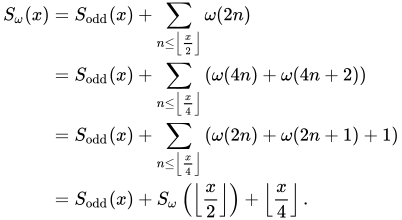
{\displaystyle {\begin{aligned}S_{\omega }(x)&=S_{\operatorname {odd} }(x)+\sum _{n\leq \left\lfloor {\frac {x}{2}}\right\rfloor }\omega (2n)\\&=S_{\operatorname {odd} }(x)+\sum _{n\leq \left\lfloor {\frac {x}{4}}\right\rfloor }\left(\omega (4n)+\omega (4n+2)\right)\\&=S_{\operatorname {odd} }(x)+\sum _{n\leq \left\lfloor {\frac {x}{4}}\right\rfloor }\left(\omega (2n)+\omega (2n+1)+1\right)\\&=S_{\operatorname {odd} }(x)+S_{\omega }\left(\left\lfloor {\frac {x}{2}}\right\rfloor \right)+\left\lfloor {\frac {x}{4}}\right\rfloor .\end{aligned}}}
ω (n)[ edit ] The computations expanded in Chapter 22.11 of Hardy and Wright provide asymptotic estimates for the summatory function
ω
(
n
)
{
ω
(
n
)
−
1
}
,
{\displaystyle \omega (n)\left\{\omega (n)-1\right\},}
by estimating the product of these two component omega functions as
ω
(
n
)
{
ω
(
n
)
−
1
}
=
∑
p
,
q
prime
p
≠
q
p
q
∣
n
1
=
∑
p
,
q
prime
p
q
∣
n
1
−
∑
p
prime
p
2
∣
n
1.
{\displaystyle \omega (n)\left\{\omega (n)-1\right\}=\sum _{\stackrel {pq\mid n}{\stackrel {p\neq q}{p,q{\text{ prime}}}}}1=\sum _{\stackrel {pq\mid n}{p,q{\text{ prime}}}}1-\sum _{\stackrel {p^{2}\mid n}{p{\text{ prime}}}}1.}
We can similarly calculate asymptotic formulas more generally for the related summatory functions over so-termed factorial moments of the function
ω
(
n
)
{\displaystyle \omega (n)}
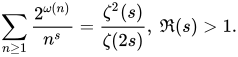
A known Dirichlet series involving
ω
(
n
)
{\displaystyle \omega (n)}
Riemann zeta function is given by [ 15]
∑
n
≥
1
2
ω
(
n
)
n
s
=
ζ
2
(
s
)
ζ
(
2
s
)
,
ℜ
(
s
)
>
1.
{\displaystyle \sum _{n\geq 1}{\frac {2^{\omega (n)}}{n^{s}}}={\frac {\zeta ^{2}(s)}{\zeta (2s)}},\ \Re (s)>1.}
We can also see that
∑
n
≥
1
z
ω
(
n
)
n
s
=
∏
p
(
1
+
z
p
s
−
1
)
,
|
z
|
<
2
,
ℜ
(
s
)
>
1
,
{\displaystyle \sum _{n\geq 1}{\frac {z^{\omega (n)}}{n^{s}}}=\prod _{p}\left(1+{\frac {z}{p^{s}-1}}\right),|z|<2,\Re (s)>1,}
∑
n
≥
1
z
Ω
(
n
)
n
s
=
∏
p
(
1
−
z
p
s
)
−
1
,
|
z
|
<
2
,
ℜ
(
s
)
>
1
,
{\displaystyle \sum _{n\geq 1}{\frac {z^{\Omega (n)}}{n^{s}}}=\prod _{p}\left(1-{\frac {z}{p^{s}}}\right)^{-1},|z|<2,\Re (s)>1,}
The function
Ω
(
n
)
{\displaystyle \Omega (n)}
completely additive , where
ω
(
n
)
{\displaystyle \omega (n)}
strongly additive (additive) . Now we can prove a short lemma in the following form which implies exact formulas for the expansions of the Dirichlet series over both
ω
(
n
)
{\displaystyle \omega (n)}
Ω
(
n
)
{\displaystyle \Omega (n)}
Lemma. Suppose that
f
{\displaystyle f}
strongly additive arithmetic function defined such that its values at prime powers is given by
f
(
p
α
)
:=
f
0
(
p
,
α
)
{\displaystyle f(p^{\alpha }):=f_{0}(p,\alpha )}
f
(
p
1
α
1
⋯
p
k
α
k
)
=
f
0
(
p
1
,
α
1
)
+
⋯
+
f
0
(
p
k
,
α
k
)
{\displaystyle f(p_{1}^{\alpha _{1}}\cdots p_{k}^{\alpha _{k}})=f_{0}(p_{1},\alpha _{1})+\cdots +f_{0}(p_{k},\alpha _{k})}
p
i
{\displaystyle p_{i}}
α
i
≥
1
{\displaystyle \alpha _{i}\geq 1}
Dirichlet series of
f
{\displaystyle f}
∑
n
≥
1
f
(
n
)
n
s
=
ζ
(
s
)
×
∑
p
p
r
i
m
e
(
1
−
p
−
s
)
⋅
∑
n
≥
1
f
0
(
p
,
n
)
p
−
n
s
,
ℜ
(
s
)
>
min
(
1
,
σ
f
)
.
{\displaystyle \sum _{n\geq 1}{\frac {f(n)}{n^{s}}}=\zeta (s)\times \sum _{p\mathrm {\ prime} }(1-p^{-s})\cdot \sum _{n\geq 1}f_{0}(p,n)p^{-ns},\Re (s)>\min(1,\sigma _{f}).}
Proof. We can see that
∑
n
≥
1
u
f
(
n
)
n
s
=
∏
p
p
r
i
m
e
(
1
+
∑
n
≥
1
u
f
0
(
p
,
n
)
p
−
n
s
)
.
{\displaystyle \sum _{n\geq 1}{\frac {u^{f(n)}}{n^{s}}}=\prod _{p\mathrm {\ prime} }\left(1+\sum _{n\geq 1}u^{f_{0}(p,n)}p^{-ns}\right).}
This implies that
∑
n
≥
1
f
(
n
)
n
s
=
d
d
u
[
∏
p
p
r
i
m
e
(
1
+
∑
n
≥
1
u
f
0
(
p
,
n
)
p
−
n
s
)
]
|
u
=
1
=
∏
p
(
1
+
∑
n
≥
1
p
−
n
s
)
×
∑
p
∑
n
≥
1
f
0
(
p
,
n
)
p
−
n
s
1
+
∑
n
≥
1
p
−
n
s
=
ζ
(
s
)
×
∑
p
p
r
i
m
e
(
1
−
p
−
s
)
⋅
∑
n
≥
1
f
0
(
p
,
n
)
p
−
n
s
,
{\displaystyle {\begin{aligned}\sum _{n\geq 1}{\frac {f(n)}{n^{s}}}&={\frac {d}{du}}\left[\prod _{p\mathrm {\ prime} }\left(1+\sum _{n\geq 1}u^{f_{0}(p,n)}p^{-ns}\right)\right]{\Biggr |}_{u=1}=\prod _{p}\left(1+\sum _{n\geq 1}p^{-ns}\right)\times \sum _{p}{\frac {\sum _{n\geq 1}f_{0}(p,n)p^{-ns}}{1+\sum _{n\geq 1}p^{-ns}}}\\&=\zeta (s)\times \sum _{p\mathrm {\ prime} }(1-p^{-s})\cdot \sum _{n\geq 1}f_{0}(p,n)p^{-ns},\end{aligned}}}
wherever the corresponding series and products are convergent. In the last equation, we have used the Euler product representation of the Riemann zeta function .
The lemma implies that for
ℜ
(
s
)
>
1
{\displaystyle \Re (s)>1}
D
ω
(
s
)
:=
∑
n
≥
1
ω
(
n
)
n
s
=
ζ
(
s
)
P
(
s
)
=
ζ
(
s
)
×
∑
n
≥
1
μ
(
n
)
n
log
ζ
(
n
s
)
D
Ω
(
s
)
:=
∑
n
≥
1
Ω
(
n
)
n
s
=
ζ
(
s
)
×
∑
n
≥
1
P
(
n
s
)
=
ζ
(
s
)
×
∑
n
≥
1
ϕ
(
n
)
n
log
ζ
(
n
s
)
D
h
(
s
)
:=
∑
n
≥
1
h
(
n
)
n
s
=
ζ
(
s
)
log
ζ
(
s
)
=
ζ
(
s
)
×
∑
n
≥
1
ε
(
n
)
n
log
ζ
(
n
s
)
,
{\displaystyle {\begin{aligned}D_{\omega }(s)&:=\sum _{n\geq 1}{\frac {\omega (n)}{n^{s}}}=\zeta (s)P(s)\\&\ =\zeta (s)\times \sum _{n\geq 1}{\frac {\mu (n)}{n}}\log \zeta (ns)\\D_{\Omega }(s)&:=\sum _{n\geq 1}{\frac {\Omega (n)}{n^{s}}}=\zeta (s)\times \sum _{n\geq 1}P(ns)\\&\ =\zeta (s)\times \sum _{n\geq 1}{\frac {\phi (n)}{n}}\log \zeta (ns)\\D_{h}(s)&:=\sum _{n\geq 1}{\frac {h(n)}{n^{s}}}=\zeta (s)\log \zeta (s)\\&\ =\zeta (s)\times \sum _{n\geq 1}{\frac {\varepsilon (n)}{n}}\log \zeta (ns),\end{aligned}}}
where
P
(
s
)
{\displaystyle P(s)}
prime zeta function ,
h
(
n
)
=
∑
p
k
|
n
1
k
=
∑
p
k
|
|
n
H
k
{\displaystyle h(n)=\sum _{p^{k}|n}{\frac {1}{k}}=\sum _{p^{k}||n}{H_{k}}}
H
k
{\displaystyle H_{k}}
k
{\displaystyle k}
harmonic number and
ε
{\displaystyle \varepsilon }
Dirichlet convolution ,
ε
(
n
)
=
⌊
1
n
⌋
{\displaystyle \varepsilon (n)=\lfloor {\frac {1}{n}}\rfloor }
↑ This inequality is given in Section 22.13 of Hardy and Wright. ↑ S. R. Finch, Two asymptotic series, Mathematical Constants II, Cambridge Univ. Press, pp. 21-32, ↑ Each of these started from the second identity in the list are cited individually on the pages Dirichlet convolutions of arithmetic functions , Menon's identity , and other formulas for Euler's totient function . The first identity is a combination of two known divisor sums cited in Section 27.6 of the NIST Handbook of Mathematical Functions . ↑ This is suggested as an exercise in Apostol's book. Namely, we write
f
=
μ
∗
ω
{\displaystyle f=\mu \ast \omega }
f
(
n
)
=
∑
d
|
n
μ
(
n
/
d
)
∑
r
|
d
(
π
(
r
)
−
π
(
r
−
1
)
)
{\displaystyle f(n)=\sum _{d|n}\mu (n/d)\sum _{r|d}\left(\pi (r)-\pi (r-1)\right)}
f
{\displaystyle f}
D
f
(
s
)
:=
∑
n
≥
1
f
(
n
)
n
s
=
P
(
s
)
,
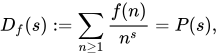
{\displaystyle D_{f}(s):=\sum _{n\geq 1}{\frac {f(n)}{n^{s}}}=P(s),}
P
(
s
)
{\displaystyle P(s)}
prime zeta function . Then it becomes obvious to see that
f
(
n
)
=
π
(
n
)
−
π
(
n
−
1
)
=
χ
P
(
n
)
{\displaystyle f(n)=\pi (n)-\pi (n-1)=\chi _{\mathbb {P} }(n)}
↑ This identity is proved in the article by Schmidt cited on this page below. ↑ This triangular sequence also shows up prominently in the Lambert series factorization theorems proved by Merca and Schmidt (2017–2018) ↑ Hoelscher, Zachary; Palsson, Eyvindur (2020-12-05). "Counting Restricted Partitions of Integers Into Fractions: Symmetry and Modes of the Generating Function and a Connection to ω(t)" . The PUMP Journal of Undergraduate Research . 3 : 277– 307. arXiv :2011.14502 doi :10.46787/pump.v3i0.2428 . ISSN 2576-3725 . ↑ Hoelscher, Zachary; Palsson, Eyvindur (2020-12-05). "Counting Restricted Partitions of Integers Into Fractions: Symmetry and Modes of the Generating Function and a Connection to ω(t)" . The PUMP Journal of Undergraduate Research . 3 : 277– 307. arXiv :2011.14502 doi :10.46787/pump.v3i0.2428 . ISSN 2576-3725 . ↑ For references to each of these average order estimates see equations (3) and (18) of the MathWorld reference and Section 22.10-22.11 of Hardy and Wright. ↑ See Sections 22.10 and 22.11 for reference and explicit derivations of these asymptotic estimates. ↑ Actually, the proof of the last result given in Hardy and Wright actually suggests a more general procedure for extracting asymptotic estimates of the moments
∑
n
≤
x
ω
(
n
)
k
{\displaystyle \sum _{n\leq x}\omega (n)^{k}}
k
≥
2
{\displaystyle k\geq 2}
factorial moments of the form
∑
n
≤
x
[
ω
(
n
)
]
!
[
ω
(
n
)
−
m
]
!
{\displaystyle \sum _{n\leq x}{\frac {\left[\omega (n)\right]!}{\left[\omega (n)-m\right]!}}}
m
≥
2
{\displaystyle m\geq 2}
↑ Cohen, Eckford (1960). "The Number of Unitary Divisors of an Integer" The American Mathematical Monthly . 67 (9): 879– 880. doi :10.2307/2309455 . ISSN 0002-9890 . JSTOR 2309455 . ↑ Hardy and Wright Chapter 22.11. ↑ N.b., this sum is suggested by work contained in an unpublished manuscript by the contributor to this page related to the growth of the Mertens function . Hence it is not just a vacuous and/or trivial estimate obtained for the purpose of exposition here. ↑ This identity is found in Section 27.4 of the NIST Handbook of Mathematical Functions . ↑ Rényi, A.; Turán, P. (1958). "On a theorem of Erdös-Kac" (PDF) . Acta Arithmetica . 4 (1): 71– 84. doi :10.4064/aa-4-1-71-84 .


















![{\displaystyle \omega (n)=\log _{2}\left[\sum _{k=1}^{n}\sum _{j=1}^{k}\left(\sum _{d\mid k}\sum _{i=1}^{d}p(d-ji)\right)s_{n,k}\cdot |\mu (j)|\right],}](https://wikimedia.org/api/rest_v1/media/math/render/svg/1f0b3b56784fcb4a1f351f833b240ba95e98e6e9)


_{\infty }{\frac {q^{k}}{1-q^{k}}}=s_{o}(n,k)-s_{e}(n,k),}](https://wikimedia.org/api/rest_v1/media/math/render/svg/040e47960bba335bacb93086587c53e5f0feb113)













![{\displaystyle S_{\operatorname {odd} }(x):=\sum _{n\leq x}\omega (n)[n{\text{ odd}}],}](https://wikimedia.org/api/rest_v1/media/math/render/svg/0a00395a9d41293adda01671f6e5090d2511805c)
![{\displaystyle [\cdot ]}](https://wikimedia.org/api/rest_v1/media/math/render/svg/41b4e841c71afe1890198191aab15bc225bbc0b6)
![{\displaystyle S_{\operatorname {odd} }(x)={\frac {x}{2}}\log \log x+{\frac {(2B_{1}-1)x}{4}}+\left\{{\frac {x}{4}}\right\}-\left[x\equiv 2,3{\bmod {4}}\right]+O\left({\frac {x}{\log x}}\right).}](https://wikimedia.org/api/rest_v1/media/math/render/svg/e69e31ab5be7d0829b790b39d3cdb50f72d11a61)











![{\displaystyle {\begin{aligned}\sum _{n\geq 1}{\frac {f(n)}{n^{s}}}&={\frac {d}{du}}\left[\prod _{p\mathrm {\ prime} }\left(1+\sum _{n\geq 1}u^{f_{0}(p,n)}p^{-ns}\right)\right]{\Biggr |}_{u=1}=\prod _{p}\left(1+\sum _{n\geq 1}p^{-ns}\right)\times \sum _{p}{\frac {\sum _{n\geq 1}f_{0}(p,n)p^{-ns}}{1+\sum _{n\geq 1}p^{-ns}}}\\&=\zeta (s)\times \sum _{p\mathrm {\ prime} }(1-p^{-s})\cdot \sum _{n\geq 1}f_{0}(p,n)p^{-ns},\end{aligned}}}](https://wikimedia.org/api/rest_v1/media/math/render/svg/70698ccff8d31b759817ede279c2db266490bc41)


![{\displaystyle N_{k}(x):=\#(\{n\in \mathbb {Z} ^{+}:\Omega (n)-\omega (n)=k\}\cap [1,x]).}](https://wikimedia.org/api/rest_v1/media/math/render/svg/b2d6aac5e611310660f4cea908856576b3c3c330)










![{\displaystyle \sum _{n\leq x}{\frac {\left[\omega (n)\right]!}{\left[\omega (n)-m\right]!}}}](https://wikimedia.org/api/rest_v1/media/math/render/svg/68e31d3fca88bf2bc915b7610f7aacbeefeb4bca)
