


Poussin proof
In number theory, a branch of mathematics, the Poussin proof is the proof of an identity related to the fractional part of a ratio.
In 1838, Peter Gustav Lejeune Dirichlet proved an approximate formula for the average number of divisors of all the numbers from 1 to n:
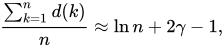
where d represents the divisor function, and γ represents the Euler-Mascheroni constant.
In 1898, Charles Jean de la Vallée-Poussin proved that if a large number n is divided by all the primes up to n, then the average fraction by which the quotient falls short of the next whole number is γ:
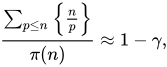
where {x} represents the fractional part of x, and π represents the prime-counting function. For example, if we divide 29 by 2, we get 14.5, which falls short of 15 by 0.5.
References
[edit]- Dirichlet, G. L. "Sur l'usage des séries infinies dans la théorie des nombres", Journal für die reine und angewandte Mathematik 18 (1838), pp. 259–274. Cited in MathWorld article "Divisor Function" below.
- de la Vallée Poussin, C.-J. Untitled communication. Annales de la Societe Scientifique de Bruxelles 22 (1898), pp. 84–90. Cited in MathWorld article "Euler-Mascheroni Constant" below.
External links
[edit]- Weisstein, Eric W. "Divisor Function". MathWorld.
- Weisstein, Eric W. "Euler-Mascheroni Constant". MathWorld.
 | This number theory–related article is a stub. You can help Wikipedia by adding missing information. |