


Physical activity level
 | This article's style of writing may not reflect the encyclopedic tone used on Wikipedia. (February 2024) |

The physical activity level (PAL) is a way to express a person's daily physical activity as a number and is used to estimate their energy expenditure.[1] In combination with the basal metabolic rate (BMR), it can be used to compute the amount of food energy a person needs to consume to maintain a particular lifestyle.
Definition
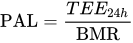
[edit]The physical activity level is defined for a non-pregnant, non-lactating adult as that person's total energy expenditure (TEE) in a 24-hour period, divided by his or her basal metabolic rate (BMR):[2]
The level of physical activity can also be estimated based on a list of the physical activities a person performs from day to day. Each activity is connected to a number, the physical activity ratio. The physical activity level is then the time-weighted average of the physical activity ratios.
Examples
[edit]The following table shows indicative numbers for the Physical activity level for several lifestyles:[3]
| Lifestyle | Example | PAL |
|---|---|---|
| Extremely inactive | Cerebral palsy patient | <1.40 |
| Sedentary | Office worker getting little or no exercise | 1.40-1.69 |
| Moderately active | Construction worker or person running one hour daily | 1.70-1.99 |
| Vigorously active | Agricultural worker (non mechanized) or person swimming two hours daily | 2.00-2.4 |
| Extremely active | Competitive cyclist | >2.40 |
See also
[edit]References
[edit]- ↑ "Total Energy Expenditure (TEE) and Physical Activity Levels (PAL) in Adults". getfitup.com. Getifitup.com. 1994-11-04. Retrieved 2024-05-23.
- ↑ "Human energy requirements: Principles and Definitions". Report of a Joint FAO/WHO/UNU Expert Consultation. Food and Agriculture Organization of the United Nations. 2004. Retrieved 2009-10-15.
- ↑ "Human energy requirements: Energy Requirement of Adults". Report of a Joint FAO/WHO/UNU Expert Consultation. Food and Agriculture Organization of the United Nations. 2004.