


Passage du Gois

The Passage du Gois (French pronunciation: [pasaʒ dy ɡwa]) or Gôa is a causeway between Beauvoir-sur-Mer and the island of Noirmoutier, in Vendée, on the Atlantic coast of France. It is 4.125 kilometres (2.6 mi) long[1] and floods twice a day during high tide. A road runs along the causeway.
Every year, a foot race—the Foulées du Gois—is held across it, starting at the onset of low tide, though professional athletes hold off until the water is as high as their shoes.[2]
Tour de France
[edit]The Passage du Gois was used in the second stage of the 1999 Tour de France bicycle race, though it proved to be divisive due to a crash caused by the slippery surface. The crash created a six-minute split in the peloton, which ended the hopes of many favourites to win the race, including Alex Zülle, who would eventually finish second overall.[3]
The causeway was used again in the 2011 race, as the starting point of the first stage.[4]
 Flooded causeway (island side)
 Tide tables
 Beacon
 Warning notice
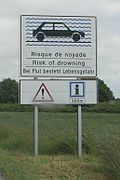 Risk of drowning


See also
[edit]- The Broomway, a similar causeway to Foulness Island in Essex, England
References
[edit]- ↑ "Le Passage du Gois". Beauvoir sur Mer (in French). Mairie de Beauvoir sur Mer. Archived from the original on 6 July 2015. Retrieved 7 July 2015.
- ↑ "Passage du Gois". aupassagedugois.fr. Retrieved 20 September 2021.
- ↑ "1999 Tour de France stage two: Passage du Gois causes chaos". Cycling Weekly. 30 June 2011. Retrieved 20 September 2021.
- ↑ "Passage du Gois, team time trial back for 2011 Tour". VeloNews. Retrieved 20 September 2021.
