


Partial geometry
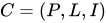
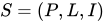
An incidence structure consists of a set of points, a set of lines, and an incidence relation, or set of flags, ; a point is said to be incident with a line if . It is a (finite) partial geometry if there are integers such that:


- For any pair of distinct points and , there is at most one line incident with both of them.
- Each line is incident with points.
- Each point is incident with lines.
- If a point and a line are not incident, there are exactly pairs , such that is incident with and is incident with .


A partial geometry with these parameters is denoted by .

Properties
[edit]- The number of points is given by and the number of lines by .
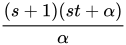
- The point graph (also known as the collinearity graph) of a is a strongly regular graph: .
- Partial geometries are dualizable structures: the dual of a is simply a .


Special cases
[edit]- The generalized quadrangles are exactly those partial geometries with .
- The Steiner systems are precisely those partial geometries with .



Generalisations
[edit]A partial linear space of order is called a semipartial geometry if there are integers such that:


- If a point and a line are not incident, there are either or exactly pairs , such that is incident with and is incident with .
- Every pair of non-collinear points have exactly common neighbours.


A semipartial geometry is a partial geometry if and only if .
It can be easily shown that the collinearity graph of such a geometry is strongly regular with parameters .

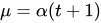
A nice example of such a geometry is obtained by taking the affine points of and only those lines that intersect the plane at infinity in a point of a fixed Baer subplane; it has parameters .


See also
[edit]References
[edit]- Brouwer, A.E.; van Lint, J.H. (1984), "Strongly regular graphs and partial geometries", in Jackson, D.M.; Vanstone, S.A. (eds.), Enumeration and Design, Toronto: Academic Press, pp. 85–122
- Bose, R. C. (1963), "Strongly regular graphs, partial geometries and partially balanced designs" (PDF), Pacific J. Math., 13: 389–419, doi:10.2140/pjm.1963.13.389
- De Clerck, F.; Van Maldeghem, H. (1995), "Some classes of rank 2 geometries", Handbook of Incidence Geometry, Amsterdam: North-Holland, pp. 433–475
- Thas, J.A. (2007), "Partial Geometries", in Colbourn, Charles J.; Dinitz, Jeffrey H. (eds.), Handbook of Combinatorial Designs (2nd ed.), Boca Raton: Chapman & Hall/ CRC, pp. 557–561, ISBN 1-58488-506-8
- Debroey, I.; Thas, J. A. (1978), "On semipartial geometries", Journal of Combinatorial Theory, Series A, 25: 242–250, doi:10.1016/0097-3165(78)90016-x