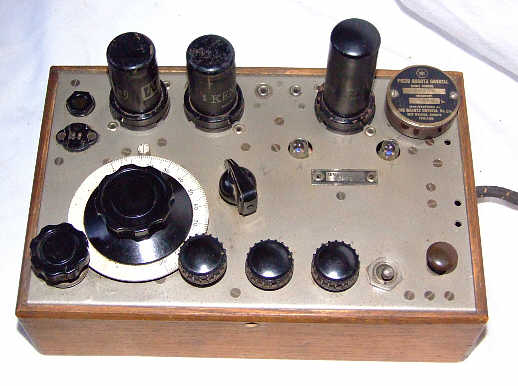
Paraset


_Museon-Omniversum.jpg)
The Paraset was a small, low-power, thermionic valve, CW-only radio transmitter-receiver supplied to the resistance groups in France, Belgium and the Netherlands during World War II.[1]
History
[edit]The Paraset was one of the first successful miniaturized radio sets for Britain's Special Operations Executive which conducted espionage and other underground activities behind German lines during World War II.[2]
The set, known as the Whaddon Mark VII, was used for clandestine radio communication primarily in Norway and Europe, developed at the Royal Signals Special Communications Unit workshops at Little Horwood and the workshops of Whaddon Hall, Buckinghamshire under advice from Lieutenant Colonel Frederick W. Nicholls (SOE Director of Signals) in the early stages of World War II. The equipment is known as the "Paraset" because it was dropped by parachute insertion for field agents and resistance cells.[3][4][5]
A number of amateur radio operators build and operate replicas of the Paraset.[6]
Features
[edit]- Independent Tuning: The transmitter frequency was fixed by inserting a specific quartz crystal into the top panel. The operator could then freely tune the receiver across the band to listen for incoming signals.
- No Volume Control: To adapt to the bare-bones setup, operators adjusted the volume simply by physically shifting the headphones over their ears.
Risks
[edit]- The "Leaking" Danger: Because it used a basic regenerative receiver design without an RF pre-amplifier, the radio accidentally leaked an oscillation signal through the antenna even while just receiving. This signal could be picked up by German radio direction-finding (RDF) vehicles.
- 5-Minute Rule: To avoid capture by RDF vans, agents were strictly instructed to keep their transmission sessions under five minutes.
Specifications
[edit]Transceiver
[edit]- Type: Vacuum tube (valve) transmitter and receiver with independent circuits.
- Mode: Continuous Wave (CW) only, meaning it operated exclusively via Morse code.
- Dimensions: 222 x 142 x 110 mm
- Valves (Tubes): Three in total—two 6SK7 metal tubes for the regenerative receiver (detector and audio amplifier) and one 6V6 power tube acting as the crystal oscillator for the transmitter.
- Weight: 2.3 lbs / 1.04 kg
- Variants: Mk VII In wooden enclosure / Mk VII/2 In metal enclosure
- Receiver coverage: 3.0 to 7.6 MHz, one band (spanning the 40-meter and 80-meter amateur radio bands).
- Transmitter coverage: slightly more than 3.0 to 7.6 MHz, two bands, selectable.
- Power output: 4 to 5 watts.[7]
- Power Source: Powered via AC mains or a 6V/12V vehicle battery paired with a noisy "vibrator" power pack to step up the voltage. Operated with a long-wire antenna and a ground connection.
Transmitter
[edit]- Modulation: CW
- Frequency: 3.3 - 7.6 MHz
- Ranges: (1) 3.3 - 4.5 MHz, (2) 4.5 - 7.6 MHz
- Output: 4 - 5 W
- Circuit: Oscillator/PA
- Valve: 6V6
- Morse key: Internal only
- HT: 360V, 40-50mA
Power Supply Unit
[edit]- Input: 110 - 240V AC (6 steps), 40 - 60Hz
- Current: LT: 950mA, HT: 10mA (RX), 40-50mA (TX)
- Valve: 6X5 (rectifier)
- Dimensions: 114 x 110 x 110 mm
- Weight: 2700 g / 2.7kg
Main Components
[edit]- MK VII (Paraset)
- Headphones (high impedance)
- Antenna wire
- Ground wire
- Power supply unit
- Power interconnection cable
- Crystals
- Spare parts
Users
[edit] Belgium: Belgian Resistance
 France: French Resistance
 Netherlands: Dutch Resistance Ordedienst (OD) / Dutch stay-behind (Cold War)
 Norway: Norwegian Resistance
 United Kingdom: Special Operations Executive (SIS, MI6)
See also
[edit]References
[edit]- ↑ Armement Clandestin, France 1941-1944 by Pierre Lorain, 180 pages, Publication date: 01/01/1972.
- ↑ The Paraset Radio The story of a WWII Spy-Radio and How to Build a Working Replica By Hiroki Kato, AH6CY, ISBN 9781910193952
- ↑ "Transceiver Mk VII Paraset, British". UK Imperial War Museum. Retrieved 5 July 2016.
- ↑ Peter R. Jensen (1 September 2013). Wireless at War. Rosenberg Publishing. pp. 228–. ISBN 978-1-922013-84-2.
- ↑ G4GDR; G3EFY. "The Paraset Club". theparasetclub.co.uk. The Paraset Club. Archived from the original on 11 October 2008. Retrieved 5 July 2016.
{{cite web}}: CS1 maint: numeric names: authors list (link) - ↑ Arnold, Richard. "The First QRP* Ops". ARRL. American Radio Relay League, Inc. Archived from the original on 10 February 2009. Retrieved 5 July 2016.
- ↑ Gordon, Kenneth G. "The "Paraset" Suitcase Spy Transceiver of WWII". Glowbugs. W7EKB. Archived from the original on 30 August 2006. Retrieved 5 July 2016.
External links
[edit]
- RADIO SET Mk. VII "Paraset" year 1941
- Unveiling the Secrets of the Paraset Spy Radio
- G4BXD Original Paraset photo
- IK0MOZ Italian Paraset Project
- Paraset.nl Paraset project and info from The Netherlands
- AE4IC PARASET - World War II Spy Transceiver
- WW2 Paraset Transceiver Project Guide
- Paraset WW2 SPY Tranceiver