


Palmqvist method

The Palmqvist method, or the Palmqvist toughness test, (after Sven Robert Palmqvist) is a common method to determine the fracture toughness for cemented carbides. In this case, the material's fracture toughness is given by the critical stress intensity factor KIc.[1] It was developed c. 1962.[2]
Approach
[edit]The Palmqvist-method uses the lengths of the cracks from a number of Vickers indentions to determine the fracture toughness. The Palmqvist fracture toughness is given by[1]
- in units of MPa,
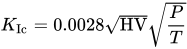

where HV is the Vickers hardness in N/mm2 (or MPa) (i.e., 9.81 x numerical HV), P is the indentation load in N (typically 30 kgf is used) and T is the total crack length (mm) after application of the indenter.
Notes
[edit]- 1 2 Roebuck, Bryan; Bennett, Eric; Lay, Lewis; Morrell, Roger (2008). "Palmqvist Toughness for Hard and Brittle Materials" (PDF). National Physical Laboratory. Retrieved 15 April 2020.
- ↑ S. Palmqvist, Occurrence of crack formation during Vickers indentation as a measure of the toughness of hard materials, Arch Eisenhuettenwes, 33 (1962) 629-333.