


Nevanlinna function
 | This article includes a list of general references but lacks sufficient corresponding inline citations. (March 2021) |
In mathematics, in the field of complex analysis, a Nevanlinna function is a complex function which is an analytic function on the open upper half-plane and has a non-negative imaginary part. A Nevanlinna function maps the upper half-plane to itself or a real constant,[1] but is not necessarily injective or surjective. Functions with this property are sometimes also known as Herglotz, Pick or R functions.

Integral representation
[edit]Every Nevanlinna function N admits a representation

where C is a real constant, D is a non-negative constant, is the upper half-plane, and μ is a Borel measure on ℝ satisfying the growth condition

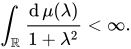
Conversely, every function of this form turns out to be a Nevanlinna function. The constants in this representation are related to the function N via

and the Borel measure μ can be recovered from N by employing the Stieltjes inversion formula (related to the inversion formula for the Stieltjes transformation):
![{\displaystyle \mu {\big (}(\lambda _{1},\lambda _{2}]{\big )}=\lim _{\delta \rightarrow 0}\lim _{\varepsilon \rightarrow 0}{\frac {1}{\pi }}\int _{\lambda _{1}+\delta }^{\lambda _{2}+\delta }\Im {\big (}N(\lambda +i\varepsilon ){\big )}\operatorname {d} \lambda .}](https://wikimedia.org/api/rest_v1/media/math/render/svg/8abb87b10488af44e410049f3dd96299c58b4693)
A very similar representation of functions is also called the Poisson representation.[2]
Examples
[edit]Some elementary examples of Nevanlinna functions follow (with appropriately chosen branch cuts in the first three). ( can be replaced by for any real number .)




- These are injective but when p does not equal 1 or −1 they are not surjective and can be rotated to some extent around the origin, such as .

- A sheet of such as the one with .


- (an example that is surjective but not injective).


- is a Nevanlinna function if (sufficient but not necessary) is a positive real number and . This is equivalent to the set of such transformations that map the real axis to itself. One may then add any constant in the upper half-plane, and move the pole into the lower half-plane, giving new values for the parameters. Example:



- and are examples which are entire functions. The second is neither injective nor surjective.
- If S is a self-adjoint operator in a Hilbert space and is an arbitrary vector, then the function


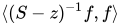
- is a Nevanlinna function.
- If and are both Nevanlinna functions, then the composition is a Nevanlinna function as well.


Importance in operator theory
[edit]Nevanlinna functions appear in the study of Operator monotone functions.
References
[edit]- ↑ A real number is not considered to be in the upper half-plane.
- ↑ See for example Section 4, "Poisson representation" in Louis de Branges (1968). Hilbert Spaces of Entire Functions. Prentice-Hall. ASIN B0006BUXNM. De Branges gives a form for functions whose real part is non-negative in the upper half-plane.
General
[edit]- Vadim Adamyan, ed. (2009). Modern analysis and applications. p. 27. ISBN 978-3-7643-9918-4.
- Naum Ilyich Akhiezer and I. M. Glazman (1993). Theory of linear operators in Hilbert space. Dover Publications. ISBN 0-486-67748-6.
- Marvin Rosenblum and James Rovnyak (1994). Topics in Hardy Classes and Univalent Functions. Springer. ISBN 3-7643-5111-X.