From Wikipedia, the free encyclopedia
In mathematics, the Neumann polynomials , introduced by Carl Neumann for the special case
α
=
0
{\displaystyle \alpha =0}
1
/
t
{\displaystyle 1/t}
Bessel functions .[ 1]
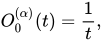
The first few polynomials are
O
0
(
α
)
(
t
)
=
1
t
,
{\displaystyle O_{0}^{(\alpha )}(t)={\frac {1}{t}},}
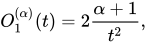
O
1
(
α
)
(
t
)
=
2
α
+
1
t
2
,
{\displaystyle O_{1}^{(\alpha )}(t)=2{\frac {\alpha +1}{t^{2}}},}
O
2
(
α
)
(
t
)
=
2
+
α
t
+
4
(
2
+
α
)
(
1
+
α
)
t
3
,
{\displaystyle O_{2}^{(\alpha )}(t)={\frac {2+\alpha }{t}}+4{\frac {(2+\alpha )(1+\alpha )}{t^{3}}},}
O
3
(
α
)
(
t
)
=
2
(
1
+
α
)
(
3
+
α
)
t
2
+
8
(
1
+
α
)
(
2
+
α
)
(
3
+
α
)
t
4
,
{\displaystyle O_{3}^{(\alpha )}(t)=2{\frac {(1+\alpha )(3+\alpha )}{t^{2}}}+8{\frac {(1+\alpha )(2+\alpha )(3+\alpha )}{t^{4}}},}
O
4
(
α
)
(
t
)
=
(
1
+
α
)
(
4
+
α
)
2
t
+
4
(
1
+
α
)
(
2
+
α
)
(
4
+
α
)
t
3
+
16
(
1
+
α
)
(
2
+
α
)
(
3
+
α
)
(
4
+
α
)
t
5
.
{\displaystyle O_{4}^{(\alpha )}(t)={\frac {(1+\alpha )(4+\alpha )}{2t}}+4{\frac {(1+\alpha )(2+\alpha )(4+\alpha )}{t^{3}}}+16{\frac {(1+\alpha )(2+\alpha )(3+\alpha )(4+\alpha )}{t^{5}}}.}
A general form for the polynomial is
O
n
(
α
)
(
t
)
=
α
+
n
2
α
∑
k
=
0
⌊
n
/
2
⌋
(
−
1
)
n
−
k
(
n
−
k
)
!
k
!
(
−
α
n
−
k
)
(
2
t
)
n
+
1
−
2
k
,
{\displaystyle O_{n}^{(\alpha )}(t)={\frac {\alpha +n}{2\alpha }}\sum _{k=0}^{\lfloor n/2\rfloor }(-1)^{n-k}{\frac {(n-k)!}{k!}}{-\alpha \choose n-k}\left({\frac {2}{t}}\right)^{n+1-2k},}
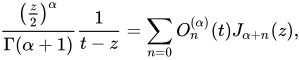
and they have the "generating function"
(
z
2
)
α
Γ
(
α
+
1
)
1
t
−
z
=
∑
n
=
0
O
n
(
α
)
(
t
)
J
α
+
n
(
z
)
,
{\displaystyle {\frac {\left({\frac {z}{2}}\right)^{\alpha }}{\Gamma (\alpha +1)}}{\frac {1}{t-z}}=\sum _{n=0}O_{n}^{(\alpha )}(t)J_{\alpha +n}(z),}
where J are Bessel functions .
To expand a function f in the form
f
(
z
)
=
(
2
z
)
α
∑
n
=
0
a
n
J
α
+
n
(
z
)
{\displaystyle f(z)=\left({\frac {2}{z}}\right)^{\alpha }\sum _{n=0}a_{n}J_{\alpha +n}(z)\,}
for
|
t
|
<
c
{\displaystyle |t|<c}
a
n
=
Γ
(
α
+
1
)
2
π
i
∮
|
t
|
=
c
′
f
(
t
)
O
n
(
α
)
(
t
)
d
t
,
{\displaystyle a_{n}={\frac {\Gamma (\alpha +1)}{2\pi i}}\oint _{|t|=c'}f(t)O_{n}^{(\alpha )}(t)\,dt,}
where
c
′
<
c
{\displaystyle c'<c}
c is the distance of the nearest singularity of f(z) from
z
=
0
{\displaystyle z=0}
An example is the extension
(
1
2
z
)
s
=
Γ
(
s
)
⋅
∑
k
=
0
(
−
1
)
k
J
s
+
2
k
(
z
)
(
s
+
2
k
)
(
−
s
k
)
,
{\displaystyle \left({\tfrac {1}{2}}z\right)^{s}=\Gamma (s)\cdot \sum _{k=0}(-1)^{k}J_{s+2k}(z)(s+2k){-s \choose k},}
or the more general Sonine formula[ 2]
e
i
γ
z
=
Γ
(
s
)
⋅
∑
k
=
0
i
k
C
k
(
s
)
(
γ
)
(
s
+
k
)
J
s
+
k
(
z
)
(
z
2
)
s
.
{\displaystyle e^{i\gamma z}=\Gamma (s)\cdot \sum _{k=0}i^{k}C_{k}^{(s)}(\gamma )(s+k){\frac {J_{s+k}(z)}{\left({\frac {z}{2}}\right)^{s}}}.}
where
C
k
(
s
)
{\displaystyle C_{k}^{(s)}}
Gegenbauer's polynomial . Then,[ citation needed ] [ original research? ]
(
z
2
)
2
k
(
2
k
−
1
)
!
J
s
(
z
)
=
∑
i
=
k
(
−
1
)
i
−
k
(
i
+
k
−
1
2
k
−
1
)
(
i
+
k
+
s
−
1
2
k
−
1
)
(
s
+
2
i
)
J
s
+
2
i
(
z
)
,
{\displaystyle {\frac {\left({\frac {z}{2}}\right)^{2k}}{(2k-1)!}}J_{s}(z)=\sum _{i=k}(-1)^{i-k}{i+k-1 \choose 2k-1}{i+k+s-1 \choose 2k-1}(s+2i)J_{s+2i}(z),}
∑
n
=
0
t
n
J
s
+
n
(
z
)
=
e
t
z
2
t
s
∑
j
=
0
(
−
z
2
t
)
j
j
!
γ
(
j
+
s
,
t
z
2
)
Γ
(
j
+
s
)
=
∫
0
∞
e
−
z
x
2
2
t
z
x
t
J
s
(
z
1
−
x
2
)
1
−
x
2
s
d
x
,
{\displaystyle \sum _{n=0}t^{n}J_{s+n}(z)={\frac {e^{\frac {tz}{2}}}{t^{s}}}\sum _{j=0}{\frac {\left(-{\frac {z}{2t}}\right)^{j}}{j!}}{\frac {\gamma \left(j+s,{\frac {tz}{2}}\right)}{\,\Gamma (j+s)}}=\int _{0}^{\infty }e^{-{\frac {zx^{2}}{2t}}}{\frac {zx}{t}}{\frac {J_{s}(z{\sqrt {1-x^{2}}})}{{\sqrt {1-x^{2}}}^{s}}}\,dx,}
the confluent hypergeometric function
M
(
a
,
s
,
z
)
=
Γ
(
s
)
∑
k
=
0
∞
(
−
1
t
)
k
L
k
(
−
a
−
k
)
(
t
)
J
s
+
k
−
1
(
2
t
z
)
(
t
z
)
s
−
k
−
1
,
{\displaystyle M(a,s,z)=\Gamma (s)\sum _{k=0}^{\infty }\left(-{\frac {1}{t}}\right)^{k}L_{k}^{(-a-k)}(t){\frac {J_{s+k-1}\left(2{\sqrt {tz}}\right)}{({\sqrt {tz}})^{s-k-1}}},}
and in particular
J
s
(
2
z
)
z
s
=
4
s
Γ
(
s
+
1
2
)
π
e
2
i
z
∑
k
=
0
L
k
(
−
s
−
1
/
2
−
k
)
(
i
t
4
)
(
4
i
z
)
k
J
2
s
+
k
(
2
t
z
)
t
z
2
s
+
k
,
{\displaystyle {\frac {J_{s}(2z)}{z^{s}}}={\frac {4^{s}\Gamma \left(s+{\frac {1}{2}}\right)}{\sqrt {\pi }}}e^{2iz}\sum _{k=0}L_{k}^{(-s-1/2-k)}\left({\frac {it}{4}}\right)(4iz)^{k}{\frac {J_{2s+k}\left(2{\sqrt {tz}}\right)}{{\sqrt {tz}}^{2s+k}}},}
the index shift formula
Γ
(
ν
−
μ
)
J
ν
(
z
)
=
Γ
(
μ
+
1
)
∑
n
=
0
Γ
(
ν
−
μ
+
n
)
n
!
Γ
(
ν
+
n
+
1
)
(
z
2
)
ν
−
μ
+
n
J
μ
+
n
(
z
)
,
{\displaystyle \Gamma (\nu -\mu )J_{\nu }(z)=\Gamma (\mu +1)\sum _{n=0}{\frac {\Gamma (\nu -\mu +n)}{n!\Gamma (\nu +n+1)}}\left({\frac {z}{2}}\right)^{\nu -\mu +n}J_{\mu +n}(z),}
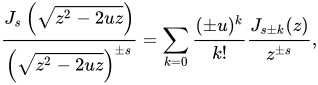
the Taylor expansion (addition formula)
J
s
(
z
2
−
2
u
z
)
(
z
2
−
2
u
z
)
±
s
=
∑
k
=
0
(
±
u
)
k
k
!
J
s
±
k
(
z
)
z
±
s
,
{\displaystyle {\frac {J_{s}\left({\sqrt {z^{2}-2uz}}\right)}{\left({\sqrt {z^{2}-2uz}}\right)^{\pm s}}}=\sum _{k=0}{\frac {(\pm u)^{k}}{k!}}{\frac {J_{s\pm k}(z)}{z^{\pm s}}},}
(cf.[ 3] [ failed verification ]
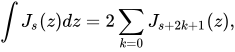
∫
J
s
(
z
)
d
z
=
2
∑
k
=
0
J
s
+
2
k
+
1
(
z
)
,
{\displaystyle \int J_{s}(z)dz=2\sum _{k=0}J_{s+2k+1}(z),}
are of the same type.
↑ Abramowitz and Stegun , p. 363, 9.1.82 ff.↑ Erdélyi, Arthur; Magnus, Wilhelm; Oberhettinger, Fritz; Tricomi, Francesco G. (1955), Higher Transcendental Functions. Vols. I, II, III , McGraw-Hill, MR 0058756 ↑ Gradshteyn, Izrail Solomonovich ; Ryzhik, Iosif Moiseevich ; Geronimus, Yuri Veniaminovich ; Tseytlin, Michail Yulyevich ; Jeffrey, Alan (2015) [October 2014]. "8.515.1.". In Zwillinger, Daniel; Moll, Victor Hugo (eds.). Table of Integrals, Series, and Products ed.). Academic Press, Inc. p. 944. ISBN 0-12-384933-0 LCCN 2014010276 .