


Monoid ring
In abstract algebra, a monoid ring is a ring constructed from a ring and a monoid, just as a group ring is constructed from a ring and a group.
Definition
[edit]Let R be a ring and let G be a monoid. The monoid ring or monoid algebra of G over R, denoted R[G] or RG, is the set of formal sums , where for each and rg = 0 for all but finitely many g, equipped with coefficient-wise addition, and the multiplication in which the elements of R commute with the elements of G. More formally, R[G] is the free R-module on the set G, endowed with R-linear multiplication defined on the base elements by g·h := gh, where the left-hand side is understood as the multiplication in R[G] and the right-hand side is understood in G.


Alternatively, one can identify the element with the function eg that maps g to 1 and every other element of G to 0. This way, R[G] is identified with the set of functions φ: G → R such that {g : φ(g) ≠ 0} is finite. equipped with addition of functions, and with multiplication defined by
![{\displaystyle g\in R[G]}](https://wikimedia.org/api/rest_v1/media/math/render/svg/1c0ca2e73ba35c35345c584d8c97d972536bfc77)
- .

If G is a group, then R[G] is also called the group ring of G over R.
Universal property
[edit]Given R and G, there is a ring homomorphism α: R → R[G] sending each r to r1 (where 1 is the identity element of G), and a monoid homomorphism β: G → R[G] (where the latter is viewed as a monoid under multiplication) sending each g to 1g (where 1 is the multiplicative identity of R). We have that α(r) commutes with β(g) for all r in R and g in G.
The universal property of the monoid ring states that given a ring S, a ring homomorphism α': R → S, and a monoid homomorphism β': G → S to the multiplicative monoid of S, such that α'(r) commutes with β'(g) for all r in R and g in G, there is a unique ring homomorphism γ: R[G] → S such that composing α and β with γ produces α' and β '.
Augmentation
[edit]The augmentation is the ring homomorphism η: R[G] → R defined by
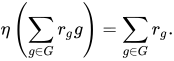
The kernel of η is called the augmentation ideal. It is a free R-module with basis consisting of 1 – g for all g in G not equal to 1.
Examples
[edit]Given a ring R and the (additive) monoid of natural numbers N (or {xn} viewed multiplicatively), we obtain the ring R[{xn}] =: R[x] of polynomials over R. The monoid Nn (with the addition) gives the polynomial ring with n variables: R[Nn] =: R[X1, ..., Xn].
Generalization
[edit]If G is a semigroup, the same construction yields a semigroup ring R[G].
See also
[edit]References
[edit]- Lang, Serge (2002). Algebra. Graduate Texts in Mathematics. Vol. 211 (Rev. 3rd ed.). New York: Springer-Verlag. ISBN 0-387-95385-X.
Further reading
[edit]- R.Gilmer. Commutative semigroup rings. University of Chicago Press, Chicago–London, 1984