


Monogenic function
A monogenic[1][2] function is a complex function with a single finite derivative. More precisely, a function defined on is called monogenic at , if exists and is finite, with:


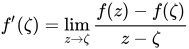
Alternatively, it can be defined as the above limit having the same value for all paths. Functions can either have a single derivative (monogenic) or infinitely many derivatives (polygenic), with no intermediate cases.[2] Furthermore, a function which is monogenic , is said to be monogenic on , and if is a domain of , then it is analytic as well (The notion of domains can also be generalized [1] in a manner such that functions which are monogenic over non-connected subsets of , can show a weakened form of analyticity)


References
[edit]- 1 2 "Monogenic function". Encyclopedia of Math. Retrieved 15 January 2021.
- 1 2 "Monogenic Function". Wolfram MathWorld. Retrieved 15 January 2021.
- ↑ Jahnke, H. N., ed. (2003). A history of analysis. History of mathematics. Providence, RI : [London]: American Mathematical Society; London Mathematical Society. p. 229. ISBN 978-0-8218-2623-2.
 | This mathematical analysis–related article is a stub. You can help Wikipedia by adding missing information. |