


Modulus of convergence
In real analysis, a branch of mathematics, a modulus of convergence is a function that tells how quickly a convergent sequence converges. These moduli are often employed in the study of computable analysis and constructive mathematics.
If a sequence of real numbers converges to a real number , then by definition, for every real there is a natural number such that if then . A modulus of convergence is essentially a function that, given , returns a corresponding value of .


Examples
[edit]Suppose that is a convergent sequence of real numbers with limit . There are two common ways of defining a modulus of convergence as a function from natural numbers to natural numbers:
- As a function such that for all , if then .
- As a function such that for all , if then .


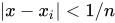



The latter definition is often employed in constructive settings, where the limit may actually be identified with the convergent sequence. Some authors use an alternate definition that replaces with .


See also
[edit]References
[edit]- Klaus Weihrauch (2000), Computable Analysis.