


Mayer f-function
The Mayer f-function is an auxiliary function that often appears in the series expansion of thermodynamic quantities related to classical many-particle systems.[1] It is named after chemist and physicist Joseph Edward Mayer.
Definition
[edit]Consider a system of classical particles interacting through a pair-wise potential

where the bold labels and denote the continuous degrees of freedom associated with the particles, e.g.,


for spherically symmetric particles and

for rigid non-spherical particles where denotes position and the orientation parametrized e.g. by Euler angles. The Mayer f-function is then defined as



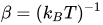
where the inverse absolute temperature in units of energy−1 .
See also
[edit]Notes
[edit]- ↑ Donald Allan McQuarrie, Statistical Mechanics (HarperCollins, 1976), page 228