Concept in statistics
Matrix t Notation
T
n
,
p
(
ν
,
M
,
Σ
,
Ω
)
{\displaystyle {\rm {T}}_{n,p}(\nu ,\mathbf {M} ,{\boldsymbol {\Sigma }},{\boldsymbol {\Omega }})}
Parameters
M
{\displaystyle \mathbf {M} }
location (real
n
×
p
{\displaystyle n\times p}
matrix )
Ω
{\displaystyle {\boldsymbol {\Omega }}}
scale (positive-definite real
n
×
n
{\displaystyle n\times n}
matrix )
Σ
{\displaystyle {\boldsymbol {\Sigma }}}
scale (positive-definite real
p
×
p
{\displaystyle p\times p}
matrix )
ν
>
0
{\displaystyle \nu >0}
degrees of freedom (real) Support
X
∈
R
n
×
p
{\displaystyle \mathbf {X} \in \mathbb {R} ^{n\times p}}
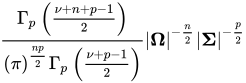
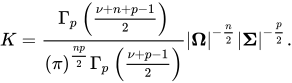
PDF
Γ
p
(
ν
+
n
+
p
−
1
2
)
(
π
)
n
p
2
Γ
p
(
ν
+
p
−
1
2
)
|
Ω
|
−
n
2
|
Σ
|
−
p
2
{\displaystyle {\frac {\Gamma _{p}\left({\frac {\nu +n+p-1}{2}}\right)}{(\pi )^{\frac {np}{2}}\Gamma _{p}\left({\frac {\nu +p-1}{2}}\right)}}|{\boldsymbol {\Omega }}|^{-{\frac {n}{2}}}|{\boldsymbol {\Sigma }}|^{-{\frac {p}{2}}}}
×
|
I
p
+
Σ
−
1
(
X
−
M
)
Ω
−
1
(
X
−
M
)
T
|
−
ν
+
n
+
p
−
1
2
{\displaystyle \times \left|\mathbf {I} _{p}+{\boldsymbol {\Sigma }}^{-1}(\mathbf {X} -\mathbf {M} ){\boldsymbol {\Omega }}^{-1}(\mathbf {X} -\mathbf {M} )^{\rm {T}}\right|^{-{\frac {\nu +n+p-1}{2}}}}
CDF
No analytic expression Mean
M
{\displaystyle \mathbf {M} }
ν
>
1
{\displaystyle \nu >1}
Mode
M
{\displaystyle \mathbf {M} }
Variance
c
o
v
(
v
e
c
(
X
)
)
=
Σ
⊗
Ω
ν
−
2
{\displaystyle \mathrm {cov} (\mathrm {vec} (\mathbf {X} ))={\frac {{\boldsymbol {\Sigma }}\otimes {\boldsymbol {\Omega }}}{\nu -2}}}
ν
>
2
{\displaystyle \nu >2}
CF
see below
In statistics , the matrix t -distribution (or matrix variate t -distribution ) is the generalization of the multivariate t -distribution from vectors to matrices .[ 1] [ 2]
The matrix t -distribution shares the same relationship with the multivariate t -distribution that the matrix normal distribution shares with the multivariate normal distribution : If the matrix has only one row, or only one column, the distributions become equivalent to the corresponding (vector-)multivariate distribution. The matrix t -distribution is the compound distribution that results from an infinite mixture of a matrix normal distribution with an inverse Wishart distribution placed over either of its covariance matrices,[ 1] t -distribution can be generated in a similar way.[ 2]
In a Bayesian analysis of a multivariate linear regression model based on the matrix normal distribution, the matrix t -distribution is the posterior predictive distribution .[ 3]
If
X
∼
T
n
×
p
(
ν
,
M
,
Σ
,
Ω
)
{\displaystyle \mathbf {X} \sim {\mathcal {T}}_{n\times p}(\nu ,\mathbf {M} ,\mathbf {\Sigma } ,\mathbf {\Omega } )}
[ 2]
Transpose transform:
X
T
∼
T
p
×
n
(
ν
,
M
T
,
Ω
,
Σ
)
{\displaystyle \mathbf {X} ^{T}\sim {\mathcal {T}}_{p\times n}(\nu ,\mathbf {M} ^{T},\mathbf {\Omega } ,\mathbf {\Sigma } )}
Linear transform: let A (r -by-n ), be of full rank r ≤ n and B (p -by-s ), be of full rank s ≤ p , then:
A
X
B
∼
T
r
×
s
(
ν
,
A
M
B
,
A
Σ
A
T
,
B
T
Ω
B
)
{\displaystyle \mathbf {AXB} \sim {\mathcal {T}}_{r\times s}(\nu ,\mathbf {AMB} ,\mathbf {A\Sigma A} ^{T},\mathbf {B} ^{T}\mathbf {\Omega B} )}
The characteristic function and various other properties can be derived from the re-parameterised formulation (see below).
Re-parameterized matrix t -distribution [ edit ] Re-parameterized matrix t Notation
T
n
,
p
(
α
,
β
,
M
,
Σ
,
Ω
)
{\displaystyle {\rm {T}}_{n,p}(\alpha ,\beta ,\mathbf {M} ,{\boldsymbol {\Sigma }},{\boldsymbol {\Omega }})}
Parameters
M
{\displaystyle \mathbf {M} }
location (real
n
×
p
{\displaystyle n\times p}
matrix )
Ω
{\displaystyle {\boldsymbol {\Omega }}}
scale (positive-definite real
p
×
p
{\displaystyle p\times p}
matrix )
Σ
{\displaystyle {\boldsymbol {\Sigma }}}
scale (positive-definite real
n
×
n
{\displaystyle n\times n}
matrix )
α
>
(
p
−
1
)
/
2
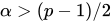
{\displaystyle \alpha >(p-1)/2}
shape parameter
β
>
0
{\displaystyle \beta >0}
scale parameter Support
X
∈
R
n
×
p
{\displaystyle \mathbf {X} \in \mathbb {R} ^{n\times p}}
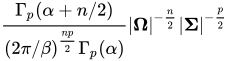
PDF
Γ
p
(
α
+
n
/
2
)
(
2
π
/
β
)
n
p
2
Γ
p
(
α
)
|
Ω
|
−
n
2
|
Σ
|
−
p
2
{\displaystyle {\frac {\Gamma _{p}(\alpha +n/2)}{(2\pi /\beta )^{\frac {np}{2}}\Gamma _{p}(\alpha )}}|{\boldsymbol {\Omega }}|^{-{\frac {n}{2}}}|{\boldsymbol {\Sigma }}|^{-{\frac {p}{2}}}}
×
|
I
n
+
β
2
Σ
−
1
(
X
−
M
)
Ω
−
1
(
X
−
M
)
T
|
−
(
α
+
n
/
2
)
{\displaystyle \times \left|\mathbf {I} _{n}+{\frac {\beta }{2}}{\boldsymbol {\Sigma }}^{-1}(\mathbf {X} -\mathbf {M} ){\boldsymbol {\Omega }}^{-1}(\mathbf {X} -\mathbf {M} )^{\rm {T}}\right|^{-(\alpha +n/2)}}
CDF
No analytic expression Mean
M
{\displaystyle \mathbf {M} }
α
>
p
/
2
{\displaystyle \alpha >p/2}
Variance
2
(
Σ
⊗
Ω
)
β
(
2
α
−
p
−
1
)
{\displaystyle {\frac {2({\boldsymbol {\Sigma }}\otimes {\boldsymbol {\Omega }})}{\beta (2\alpha -p-1)}}}
α
>
(
p
+
1
)
/
2
{\displaystyle \alpha >(p+1)/2}
CF
see below
An alternative parameterisation of the matrix t -distribution uses two parameters
α
{\displaystyle \alpha }
β
{\displaystyle \beta }
ν
{\displaystyle \nu }
[ 3]
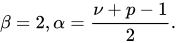
This formulation reduces to the standard matrix t -distribution with
β
=
2
,
α
=
ν
+
p
−
1
2
.
{\displaystyle \beta =2,\alpha ={\frac {\nu +p-1}{2}}.}
This formulation of the matrix t -distribution can be derived as the compound distribution that results from an infinite mixture of a matrix normal distribution with an inverse multivariate gamma distribution placed over either of its covariance matrices.
If
X
∼
T
n
,
p
(
α
,
β
,
M
,
Σ
,
Ω
)
{\displaystyle \mathbf {X} \sim {\rm {T}}_{n,p}(\alpha ,\beta ,\mathbf {M} ,{\boldsymbol {\Sigma }},{\boldsymbol {\Omega }})}
[ 2] [ 3]
X
T
∼
T
p
,
n
(
α
,
β
,
M
T
,
Ω
,
Σ
)
.
{\displaystyle \mathbf {X} ^{\rm {T}}\sim {\rm {T}}_{p,n}(\alpha ,\beta ,\mathbf {M} ^{\rm {T}},{\boldsymbol {\Omega }},{\boldsymbol {\Sigma }}).}
The property above comes from Sylvester's determinant theorem :
det
(
I
n
+
β
2
Σ
−
1
(
X
−
M
)
Ω
−
1
(
X
−
M
)
T
)
=
{\displaystyle \det \left(\mathbf {I} _{n}+{\frac {\beta }{2}}{\boldsymbol {\Sigma }}^{-1}(\mathbf {X} -\mathbf {M} ){\boldsymbol {\Omega }}^{-1}(\mathbf {X} -\mathbf {M} )^{\rm {T}}\right)=}
det
(
I
p
+
β
2
Ω
−
1
(
X
T
−
M
T
)
Σ
−
1
(
X
T
−
M
T
)
T
)
.
{\displaystyle \det \left(\mathbf {I} _{p}+{\frac {\beta }{2}}{\boldsymbol {\Omega }}^{-1}(\mathbf {X} ^{\rm {T}}-\mathbf {M} ^{\rm {T}}){\boldsymbol {\Sigma }}^{-1}(\mathbf {X} ^{\rm {T}}-\mathbf {M} ^{\rm {T}})^{\rm {T}}\right).}
If
X
∼
T
n
,
p
(
α
,
β
,
M
,
Σ
,
Ω
)
{\displaystyle \mathbf {X} \sim {\rm {T}}_{n,p}(\alpha ,\beta ,\mathbf {M} ,{\boldsymbol {\Sigma }},{\boldsymbol {\Omega }})}
A
(
n
×
n
)
{\displaystyle \mathbf {A} (n\times n)}
B
(
p
×
p
)
{\displaystyle \mathbf {B} (p\times p)}
nonsingular matrices then[ 2] [ 3]
A
X
B
∼
T
n
,
p
(
α
,
β
,
A
M
B
,
A
Σ
A
T
,
B
T
Ω
B
)
.
{\displaystyle \mathbf {AXB} \sim {\rm {T}}_{n,p}(\alpha ,\beta ,\mathbf {AMB} ,\mathbf {A} {\boldsymbol {\Sigma }}\mathbf {A} ^{\rm {T}},\mathbf {B} ^{\rm {T}}{\boldsymbol {\Omega }}\mathbf {B} ).}
The characteristic function is[ 3]
ϕ
T
(
Z
)
=
exp
(
t
r
(
i
Z
′
M
)
)
|
Ω
|
α
Γ
p
(
α
)
(
2
β
)
α
p
|
Z
′
Σ
Z
|
α
B
α
(
1
2
β
Z
′
Σ
Z
Ω
)
,
{\displaystyle \phi _{T}(\mathbf {Z} )={\frac {\exp({\rm {tr}}(i\mathbf {Z} '\mathbf {M} ))|{\boldsymbol {\Omega }}|^{\alpha }}{\Gamma _{p}(\alpha )(2\beta )^{\alpha p}}}|\mathbf {Z} '{\boldsymbol {\Sigma }}\mathbf {Z} |^{\alpha }B_{\alpha }\left({\frac {1}{2\beta }}\mathbf {Z} '{\boldsymbol {\Sigma }}\mathbf {Z} {\boldsymbol {\Omega }}\right),}
where
B
δ
(
W
Z
)
=
|
W
|
−
δ
∫
S
>
0
exp
(
t
r
(
−
S
W
−
S
−
1
Z
)
)
|
S
|
−
δ
−
1
2
(
p
+
1
)
d
S
,
{\displaystyle B_{\delta }(\mathbf {WZ} )=|\mathbf {W} |^{-\delta }\int _{\mathbf {S} >0}\exp \left({\rm {tr}}(-\mathbf {SW} -\mathbf {S^{-1}Z} )\right)|\mathbf {S} |^{-\delta -{\frac {1}{2}}(p+1)}d\mathbf {S} ,}
and where
B
δ
{\displaystyle B_{\delta }}
Bessel function of Herz[ clarification needed ]
1 2 Zhu, Shenghuo and Kai Yu and Yihong Gong (2007). "Predictive Matrix-Variate t Models." In J. C. Platt, D. Koller, Y. Singer, and S. Roweis, editors, NIPS '07: Advances in Neural Information Processing Systems 20, pages 1721–1728. MIT Press, Cambridge, MA, 2008. The notation is changed a bit in this article for consistency with the matrix normal distribution article. 1 2 3 4 5 Gupta, Arjun K and Nagar, Daya K (1999). Matrix variate distributions . CRC Press. pp. Chapter 4. {{cite book }}: CS1 maint: multiple names: authors list (link )1 2 3 4 5 Iranmanesh, Anis, M. Arashi and S. M. M. Tabatabaey (2010). "On Conditional Applications of Matrix Variate Normal Distribution" Archived 2016-03-04 at the Wayback Machine Iranian Journal of Mathematical Sciences and Informatics , 5:2, pp. 33–43.
Discrete
with finite with infinite
Continuous
supported on a supported on a supported with support
Mixed
Multivariate Directional Degenerate singular Families
Concepts Ensembles Laws Techniques










![{\displaystyle E[\mathbf {X} ]=\mathbf {M} }](https://wikimedia.org/api/rest_v1/media/math/render/svg/b42fa592683295b227432c1af033cbfcf14e62ce)
![{\displaystyle E[(\mathbf {X} -\mathbf {M} )(\mathbf {X} -\mathbf {M} )^{T}]={\frac {\mathbf {\Sigma } \operatorname {tr} (\mathbf {\Omega } )}{\nu -2}}}](https://wikimedia.org/api/rest_v1/media/math/render/svg/2d002d3e67f2344dcc33264784a79fe0ac877eac)
![{\displaystyle E[(\mathbf {X} -\mathbf {M} )^{T}(\mathbf {X} -\mathbf {M} )]={\frac {\mathbf {\Omega } \operatorname {tr} (\mathbf {\Sigma } )}{\nu -2}}}](https://wikimedia.org/api/rest_v1/media/math/render/svg/fddc9d4d9910044031fc1232a3e10f920aa32de0)

![{\displaystyle {\begin{aligned}E[(\mathbf {X} -\mathbf {M} )\mathbf {A} (\mathbf {X} -\mathbf {M} )^{T}]&={\frac {\mathbf {\Sigma } \operatorname {tr} (\mathbf {A} ^{T}\mathbf {\Omega } )}{\nu -2}}\\E[(\mathbf {X} -\mathbf {M} )^{T}\mathbf {B} (\mathbf {X} -\mathbf {M} )]&={\frac {\mathbf {\Omega } \operatorname {tr} (\mathbf {B} ^{T}\mathbf {\Sigma } )}{\nu -2}}\\E[(\mathbf {X} -\mathbf {M} )\mathbf {C} (\mathbf {X} -\mathbf {M} )]&={\frac {\mathbf {\Sigma } \mathbf {C} ^{T}\mathbf {\Omega } }{\nu -2}}\end{aligned}}}](https://wikimedia.org/api/rest_v1/media/math/render/svg/42d32d9bbd0bfdcef109fc446b2d1d0155540296)