


Matrix geometric method
In probability theory, the matrix geometric method is a method for the analysis of quasi-birth–death processes, continuous-time Markov chain whose transition rate matrix has a repetitive block structure.[1] The method was developed "largely by Marcel F. Neuts and his students starting around 1975."[2]
Method description
[edit]The method requires a transition rate matrix with tridiagonal block structure as follows
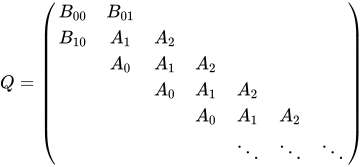
where each of B00, B01, B10, A0, A1 and A2 are matrices. To compute the stationary distribution π writing π Q = 0 the balance equations are considered for sub-vectors πi
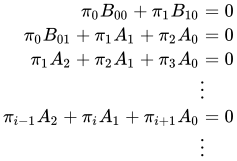
Observe that the relationship

holds where R is the Neuts' rate matrix,[3] which can be computed numerically. Using this we write

which can be solve to find π0 and π1 and therefore iteratively all the πi.
Computation of R
[edit]The matrix R can be computed using cyclic reduction[4] or logarithmic reduction.[5][6]
Matrix analytic method
[edit]The matrix analytic method is a more complicated version of the matrix geometric solution method used to analyse models with block M/G/1 matrices.[7] Such models are harder because no relationship like πi = π1 Ri – 1 used above holds.[8]
External links
[edit]- Performance Modelling and Markov Chains (part 2) by William J. Stewart at 7th International School on Formal Methods for the Design of Computer, Communication and Software Systems: Performance Evaluation
References
[edit]- ↑ Harrison, Peter G.; Patel, Naresh M. (1992). Performance Modelling of Communication Networks and Computer Architectures. Addison-Wesley. pp. 317–322. ISBN 0-201-54419-9.
- ↑ Asmussen, S. R. (2003). "Random Walks". Applied Probability and Queues. Stochastic Modelling and Applied Probability. Vol. 51. pp. 220–243. doi:10.1007/0-387-21525-5_8. ISBN 978-0-387-00211-8.
- ↑ Ramaswami, V. (1990). "A duality theorem for the matrix paradigms in queueing theory". Communications in Statistics. Stochastic Models. 6: 151–161. doi:10.1080/15326349908807141.
- ↑ Bini, D.; Meini, B. (1996). "On the Solution of a Nonlinear Matrix Equation Arising in Queueing Problems". SIAM Journal on Matrix Analysis and Applications. 17 (4): 906. doi:10.1137/S0895479895284804.
- ↑ Latouche, Guy; Ramaswami, V. (1993). "A Logarithmic Reduction Algorithm for Quasi-Birth-Death Processes". Journal of Applied Probability. 30 (3). Applied Probability Trust: 650–674. JSTOR 3214773.
- ↑ Pérez, J. F.; Van Houdt, B. (2011). "Quasi-birth-and-death processes with restricted transitions and its applications" (PDF). Performance Evaluation. 68 (2): 126. doi:10.1016/j.peva.2010.04.003. hdl:10067/859850151162165141.
- ↑ Alfa, A. S.; Ramaswami, V. (2011). "Matrix Analytic Method: Overview and History". Wiley Encyclopedia of Operations Research and Management Science. doi:10.1002/9780470400531.eorms0631. ISBN 9780470400531.
- ↑ Bolch, Gunter; Greiner, Stefan; de Meer, Hermann; Trivedi, Kishor Shridharbhai (2006). Queueing Networks and Markov Chains: Modeling and Performance Evaluation with Computer Science Applications (2 ed.). John Wiley & Sons, Inc. p. 259. ISBN 0471565253.
| Single queueing nodes | |
|---|---|
| Arrival processes | |
| Queueing networks | |
| Service policies | |
| Key concepts | |
| Limit theorems | |
| Extensions | |
| Information systems | |

 | This probability-related article is a stub. You can help Wikipedia by adding missing information. |