


Matrix factorization (algebra)
In homological algebra, a branch of mathematics, a matrix factorization is a tool used to study infinitely long resolutions, generally over commutative rings.
Motivation
[edit]One of the problems with non-smooth algebras, such as Artin algebras, are their derived categories are poorly behaved due to infinite projective resolutions. For example, in the ring there is an infinite resolution of the -module where
![{\displaystyle R=\mathbb {C} [x]/(x^{2})}](https://wikimedia.org/api/rest_v1/media/math/render/svg/4ec320ce9d7deaa0afc35dfb9eef5c9570344dfd)



Instead of looking at only the derived category of the module category, David Eisenbud[1] studied such resolutions by looking at their periodicity. In general, such resolutions are periodic with period after finitely many objects in the resolution.

Definition
[edit]For a commutative ring and an element , a matrix factorization of is a pair of n-by-n matrices such that . This can be encoded more generally as a -graded -module with an endomorphism





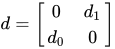
such that .

Examples
[edit](1) For and there is a matrix factorization where for .
![{\displaystyle S=\mathbb {C} [[x]]}](https://wikimedia.org/api/rest_v1/media/math/render/svg/4eba1fedf8865729b616d5b6f69f5f27578b9de6)




(2) If and , then there is a matrix factorization where
![{\displaystyle S=\mathbb {C} [[x,y,z]]}](https://wikimedia.org/api/rest_v1/media/math/render/svg/6f3cb54838138e89afa449c9b312957a21705a8a)



Periodicity
[edit]definition
Main theorem
[edit]Given a regular local ring and an ideal generated by an -sequence, set and let



be a minimal -free resolution of the ground field. Then becomes periodic after at most steps. https://www.youtube.com/watch?v=2Jo5eCv9ZVY


Maximal Cohen-Macaulay modules
[edit]page 18 of eisenbud article
Categorical structure
[edit]![[icon]](/restyle/wiki/File:Wiki_letter_w_cropped.svg) | This section needs expansion. You can help by adding missing information. (February 2022) |
Support of matrix factorizations
[edit] | This section needs expansion. You can help by adding missing information. (February 2022) |
See also
[edit]References
[edit]- ↑ Eisenbud, David (1980). "Homological Algebra on a Complete Intersection, with an Application to Group Respresentations" (PDF). Transactions of the American Mathematical Society. 260: 35–64. doi:10.1090/S0002-9947-1980-0570778-7. S2CID 27495286. Archived from the original (PDF) on 25 Feb 2020.