


Marginal model
In statistics, marginal models (Heagerty & Zeger, 2000) are a technique for obtaining regression estimates in multilevel modeling, also called hierarchical linear models. People often want to know the effect of a predictor/explanatory variable X, on a response variable Y. One way to get an estimate for such effects is through regression analysis.
Why the name marginal model?
[edit]In a typical multilevel model, there are level 1 & 2 residuals (R and U variables). The two variables form a joint distribution for the response variable (). In a marginal model, we collapse over the level 1 & 2 residuals and thus marginalize (see also conditional probability) the joint distribution into a univariate normal distribution. We then fit the marginal model to data.

For example, for the following hierarchical model,
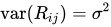
- level 1: , the residual is , and


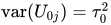
- level 2: , the residual is , and


Thus, the marginal model is,

This model is what is used to fit to data in order to get regression estimates.
References
[edit]Heagerty, P. J., & Zeger, S. L. (2000). Marginalized multilevel models and likelihood inference. Statistical Science, 15(1), 1-26.
 | This statistics-related article is a stub. You can help Wikipedia by adding missing information. |