


Mapping torus
In mathematics, specifically in topology, the mapping torus of a homeomorphism f of some topological space X to itself is a particular geometric construction with f. Take the cartesian product of X with a closed interval I, and glue the boundary components together by the static homeomorphism:
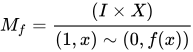
The result is a fiber bundle whose base is a circle and whose fiber is the original space X.
If X is a manifold, Mf will be a manifold of dimension one higher, and it is said to "fiber over the circle".
As a simple example, let be the circle, and be the inversion , then the mapping torus is the Klein bottle.


Mapping tori of surface homeomorphisms play a key role in the theory of 3-manifolds and have been intensely studied. If S is a closed surface of genus g ≥ 2 and if f is a self-homeomorphism of S, the mapping torus Mf is a closed 3-manifold that fibers over the circle with fiber S. A deep result of Thurston states that in this case the 3-manifold Mf is hyperbolic if and only if f is a pseudo-Anosov homeomorphism of S.[1]
References
[edit]- ↑ W. Thurston, On the geometry and dynamics of diffeomorphisms of surfaces, Bulletin of the American Mathematical Society, vol. 19 (1988), pp. 417–431