


Majority logic decoding
In error detection and correction, majority logic decoding is a method to decode repetition codes, based on the assumption that the largest number of occurrences of a symbol was the transmitted symbol.
Theory
[edit]In a binary alphabet made of , if a repetition code is used, then each input bit is mapped to the code word as a string of -replicated input bits. Generally , an odd number.


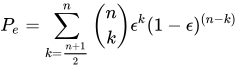
The repetition codes can detect up to transmission errors. Decoding errors occur when more than these transmission errors occur. Thus, assuming bit-transmission errors are independent, the probability of error for a repetition code is given by , where is the error over the transmission channel.
![{\displaystyle [n/2]}](https://wikimedia.org/api/rest_v1/media/math/render/svg/c00c7c3e69060d3dafc2527c65ac26009d65eaff)

Algorithm
[edit]Assumption: the code word is , where , an odd number.
- Calculate the Hamming weight of the repetition code.
- if , decode code word to be all 0's
- if , decode code word to be all 1's


This algorithm is a boolean function in its own right, the majority function.
Example
[edit]In a code, if R=[1 0 1 1 0], then it would be decoded as,
- , , so R'=[1 1 1 1 1]
- Hence the transmitted message bit was 1.

