


Local ternary patterns
 | This article needs more citations. (November 2012) |
Local ternary patterns (LTP) are an extension of local binary patterns (LBP).[1][2] Unlike LBP, it does not threshold the pixels into 0 and 1, rather it uses a threshold constant to threshold pixels into three values. Considering k as the threshold constant, c as the value of the center pixel, a neighboring pixel p, the result of threshold is:
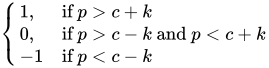
In this way, each thresholded pixel has one of the three values. Neighboring pixels are combined after thresholding into a ternary pattern. Computing a histogram of these ternary values will result in a large range, so the ternary pattern is split into two binary patterns. Histograms are concatenated to generate a descriptor double the size of LBP.
See also
[edit]References
[edit]- ↑ Xiaoyang Tan; Triggs, Bill (June 2010). "Enhanced Local Texture Feature Sets for Face Recognition Under Difficult Lighting Conditions". IEEE Transactions on Image Processing. 19 (6): 1635–1650. Bibcode:2010ITIP...19.1635T. doi:10.1109/TIP.2010.2042645. ISSN 1057-7149. PMID 20172829.
- ↑ Ji, Luping; Ren, Yan; Pu, Xiaorong; Liu, Guisong (2018-07-01). "Median local ternary patterns optimized with rotation-invariant uniform-three mapping for noisy texture classification". Pattern Recognition. 79: 387–401. Bibcode:2018PatRe..79..387J. doi:10.1016/j.patcog.2018.02.009. S2CID 13691471.
 | This computer science article is a stub. You can help Wikipedia by adding missing information. |