


Lie bialgebra
In mathematics, a Lie bialgebra is the Lie-theoretic case of a bialgebra: it is a set with a Lie algebra and a Lie coalgebra structure which are compatible.
It is a bialgebra where the multiplication is skew-symmetric and satisfies a dual Jacobi identity, so that the dual vector space is a Lie algebra, whereas the comultiplication is a 1-cocycle, so that the multiplication and comultiplication are compatible. The cocycle condition implies that, in practice, one studies only classes of bialgebras that are cohomologous to a Lie bialgebra on a coboundary.
They are also called Poisson-Hopf algebras, and are the Lie algebra of a Poisson–Lie group.
Lie bialgebras occur naturally in the study of the Yang–Baxter equations.
Definition
[edit]A vector space is a Lie bialgebra if it is a Lie algebra, and there is the structure of Lie algebra also on the dual vector space which is compatible. More precisely the Lie algebra structure on is given by a Lie bracket and the Lie algebra structure on is given by a Lie bracket . Then the map dual to is called the cocommutator, and the compatibility condition is the following cocycle relation:


![{\displaystyle [\ ,\ ]:{\mathfrak {g}}\otimes {\mathfrak {g}}\to {\mathfrak {g}}}](https://wikimedia.org/api/rest_v1/media/math/render/svg/884bd2e6680535d37dcce2cfc9e080e50a68522e)


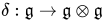
![{\displaystyle \delta ([X,Y])=\left(\operatorname {ad} _{X}\otimes 1+1\otimes \operatorname {ad} _{X}\right)\delta (Y)-\left(\operatorname {ad} _{Y}\otimes 1+1\otimes \operatorname {ad} _{Y}\right)\delta (X)}](https://wikimedia.org/api/rest_v1/media/math/render/svg/2ab46ae66c49ab1702a3cd6195be75031530ecc6)
where is the adjoint. Note that this definition is symmetric and is also a Lie bialgebra, the dual Lie bialgebra.
![{\displaystyle \operatorname {ad} _{X}Y=[X,Y]}](https://wikimedia.org/api/rest_v1/media/math/render/svg/e542dce2da64f1cc896517dea68ddbc7c2a93d33)
Example
[edit]Let be any semisimple Lie algebra. To specify a Lie bialgebra structure we thus need to specify a compatible Lie algebra structure on the dual vector space. Choose a Cartan subalgebra and a choice of positive roots. Let be the corresponding opposite Borel subalgebras, so that and there is a natural projection . Then define a Lie algebra



which is a subalgebra of the product , and has the same dimension as . Now identify with dual of via the pairing



where and is the Killing form. This defines a Lie bialgebra structure on , and is the "standard" example: it underlies the Drinfeld-Jimbo quantum group. Note that is solvable, whereas is semisimple.


Relation to Poisson–Lie groups
[edit]The Lie algebra of a Poisson–Lie group G has a natural structure of Lie bialgebra. In brief the Lie group structure gives the Lie bracket on as usual, and the linearisation of the Poisson structure on G gives the Lie bracket on (recalling that a linear Poisson structure on a vector space is the same thing as a Lie bracket on the dual vector space). In more detail, let G be a Poisson–Lie group, with being two smooth functions on the group manifold. Let be the differential at the identity element. Clearly, . The Poisson structure on the group then induces a bracket on , as




![{\displaystyle [\xi _{1},\xi _{2}]=(d\{f_{1},f_{2}\})_{e}\,}](https://wikimedia.org/api/rest_v1/media/math/render/svg/1f80ee01d840293aad4846f42be6ff80049f7ee6)
where is the Poisson bracket. Given be the Poisson bivector on the manifold, define to be the right-translate of the bivector to the identity element in G. Then one has that


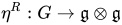
The cocommutator is then the tangent map:

so that
![{\displaystyle [\xi _{1},\xi _{2}]=\delta ^{*}(\xi _{1}\otimes \xi _{2})}](https://wikimedia.org/api/rest_v1/media/math/render/svg/b964eec2604498ad174bc9e565c5e065a9f95942)
is the dual of the cocommutator.
See also
[edit]References
[edit]- H.-D. Doebner, J.-D. Hennig, eds, Quantum groups, Proceedings of the 8th International Workshop on Mathematical Physics, Arnold Sommerfeld Institute, Claausthal, FRG, 1989, Springer-Verlag Berlin, ISBN 3-540-53503-9.
- Vyjayanthi Chari and Andrew Pressley, A Guide to Quantum Groups, (1994), Cambridge University Press, Cambridge ISBN 0-521-55884-0.
- Beisert, N.; Spill, F. (2009). "The classical r-matrix of AdS/CFT and its Lie bialgebra structure". Communications in Mathematical Physics. 285 (2): 537–565. arXiv:0708.1762. Bibcode:2009CMaPh.285..537B. doi:10.1007/s00220-008-0578-2. S2CID 8946457.