


Koenigsberger ratio
The Koenigsberger ratio is the proportion of remanent magnetization relative to induced magnetization in natural rocks.[1] It was first described by J.G. Koenigsberger.[2] It is a dimensionless parameter often used in geophysical exploration to describe the magnetic characteristics of a geological body for help in interpreting magnetic anomaly patterns.
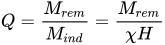
| Definition | |
|---|---|
| Q | Koenigsberger ratio |
| remanent magnetization | |
| induced magnetization | |
| χ | the magnetic susceptibility; the influence of an applied magnetic field on a material |
| H | the macroscopic magnetic field |


The total magnetization of a rock is the sum of its natural remanent magnetization and the magnetization induced by the ambient geomagnetic field. Thus, a Koenigsberger ratio, Q, greater than 1 indicates that the remanence properties contribute the majority of the total magnetization of the rock.[3]
References
[edit]- 1 2 "Königsberger Faktor". Spektrum (in German). Retrieved 2023-03-10.
- ↑ Koenigsberger, J. G. (1938). Natural residual magnetism of eruptive rocks. Terrestrial Magnetism and Atmospheric Electricity, 43(3), 299-320.
- ↑ Gubbins, D., & Herrero-Bervera, E. (Eds.). (2007). Encyclopedia of geomagnetism and paleomagnetism. Springer Science & Business Media.