


Kirwan map
In differential geometry, the Kirwan map, introduced by British mathematician Frances Kirwan, is the homomorphism

where
- is a Hamiltonian G-space; i.e., a symplectic manifold acted by a Lie group G with a moment map .
- is the equivariant cohomology ring of ; i.e.. the cohomology ring of the homotopy quotient of by .
- is the symplectic quotient of by at a regular central value of .





It is defined as the map of equivariant cohomology induced by the inclusion followed by the canonical isomorphism .
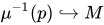

A theorem of Kirwan[1] says that if is compact, then the map is surjective in rational coefficients. The analogous result holds between the K-theory of the symplectic quotient and the equivariant topological K-theory of .[2]
References
[edit]- ↑ Kirwan, F.C. (1984). Cohomology of Quotients in Complex and Algebraic Geometry. Mathematical Notes. Vol. 31. Princeton University Press. ISBN 978-0-691-21456-6.
- ↑ Harada, M.; Landweber, G. (2007). "Surjectivity for Hamiltonian G-spaces in K-theory". Trans. Amer. Math. Soc. 359 (12): 6001–25. arXiv:math/0503609. doi:10.1090/S0002-9947-07-04164-5. JSTOR 20161853. S2CID 17690407.
 | This differential geometry–related article is a stub. You can help Wikipedia by adding missing information. |