


K-transform

In mathematics, the K transform (also called the Single-Pixel X-ray Transform) is an integral transform introduced by R. Scott Kemp and Ruaridh Macdonald in 2016.[1] The transform allows the structure of a N-dimensional inhomogeneous object to be reconstructed from scalar point measurements taken in the volume external to the object.
Gunther Uhlmann proved[2] that the K transform exhibits global uniqueness on , meaning that different objects will always have a different K transform. This uniqueness arises from the use of a monotone, nonlinear transform of the X-ray transform. By selecting the exponential function for the monotone nonlinear function, the behavior of the K transform coincides with attenuation of particles in matter as described by the Beer–Lambert law, and the K transform can therefore be used to perform tomography of objects using a low-resolution single-pixel detector.

An inversion formula based on a linearization was offered by Lai et al., who also showed that the inversion is stable under certain assumptions.[3] A numerical inversion using the BFGS optimization algorithm was explored by Fichtlscherer.[4]
Definition
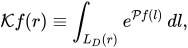
[edit]Let an object be a function of compact support that maps into the positive real numbers The K-transform of the object is defined as where is the set of all lines originating at a point and terminating on the single-pixel detector , and is the X-ray transform.


![{\displaystyle {\mathcal {K}}:L^{1}(\Omega ,\mathbb {P} _{0}^{+})\rightarrow [0,1],}](https://wikimedia.org/api/rest_v1/media/math/render/svg/e1d2b402f824378211048c24ba5698d66c10bcf9)



Proof of global uniqueness
[edit]Let be the X-ray transform transform on and let be the non-linear operator defined above. Let be the space of all Lebesgue integrable functions on , and be the essentially bounded measurable functions of the dual space. The following result says that is a monotone operator.


For such that then and the inequality is strict when .




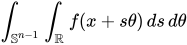
Proof. Note that is constant on lines in direction , so , where denotes orthogonal projection on . Therefore:









where is the Lebesgue measure on the hyperplane . The integrand has the form , which is negative except when and so unless almost everywhere. Then uniqueness for the X-Ray transform implies that almost everywhere.






Lai et al. generalized this proof to Riemannian manifolds.[3]
Applications
[edit]The K transform was originally developed as a means of performing a physical one-time pad encryption of a physical object.[1] The nonlinearity of the transform ensures the there is no one-to-one correspondence between the density and the true mass , and therefore cannot be estimated from a single projection.
References
[edit]- 1 2 Kemp, R. Scott; et al. (August 2, 2016). "Physical cryptographic verification of nuclear warheads". Proceedings of the National Academy of Sciences. 113 (31): 8618–8623. Bibcode:2016PNAS..113.8618K. doi:10.1073/pnas.1603916113. PMC 4978267. PMID 27432959.
- ↑ Kemp, R. Scott; et al. (August 2, 2016). "Supporting information: physical cryptographic verification of nuclear warheads" (PDF). Proceedings of the National Academy of Sciences. 113 (31): SI-5. doi:10.1073/pnas.1603916113. PMC 4978267. PMID 27432959. Retrieved 22 Feb 2021.
- 1 2 Lai, Ru-Yu; Uhlmann, Gunther; Zhai, Jian; Zhou, Hanming (2021). "Single pixel X-ray transform and related inverse problems". arXiv:2112.13978 [math.AP].
- ↑ Fichtlscherer, Christopher (19 August 2020). "The K-Transform". K-Transform Tomography: Applications in Nuclear Verification (MSc). University of Hamburg.