


K-groups of a field
In mathematics, especially in algebraic K-theory, the algebraic K-group of a field is important to compute. For a finite field, the complete calculation was given by Daniel Quillen.
Low degrees
[edit]The map sending a finite-dimensional F-vector space to its dimension induces an isomorphism

for any field F. Next,
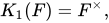
the multiplicative group of F.[1] The second K-group of a field is described in terms of generators and relations by Matsumoto's theorem.
Finite fields
[edit]The K-groups of finite fields are one of the few cases where the K-theory is known completely:[2] for ,


For n=2, this can be seen from Matsumoto's theorem, in higher degrees it was computed by Quillen in conjunction with his work on the Adams conjecture. A different proof was given by Jardine (1993).
Local and global fields
[edit]Weibel (2005) surveys the computations of K-theory of global fields (such as number fields and function fields), as well as local fields (such as p-adic numbers).
Algebraically closed fields
[edit]Suslin (1983) showed that the torsion in K-theory is insensitive to extensions of algebraically closed fields. This statement is known as Suslin rigidity.
See also
[edit]References
[edit]- ↑ Weibel 2013, Ch. III, Example 1.1.2.
- ↑ Weibel 2013, Ch. IV, Corollary 1.13.
- Jardine, J. F. (1993), "The K-theory of finite fields, revisited", K-Theory, 7 (6): 579–595, doi:10.1007/BF00961219, MR 1268594
- Suslin, Andrei (1983), "On the K-theory of algebraically closed fields", Inventiones Mathematicae, 73 (2): 241–245, Bibcode:1983InMat..73..241S, doi:10.1007/BF01394024, MR 0714090
- Weibel, Charles (2005), "Algebraic K-Theory of Rings of Integers in Local and Global Fields", in Friedlander, Eric M.; Grayson, Daniel R. (eds.), Handbook of K-Theory, Springer, pp. 139–190, doi:10.1007/978-3-540-27855-9_5, ISBN 978-3-540-27855-9
- Weibel, Charles A. (2013), The K-book, Graduate Studies in Mathematics, vol. 145, American Mathematical Society, Providence, RI, ISBN 978-0-8218-9132-2, MR 3076731
 | This algebraic geometry–related article is a stub. You can help Wikipedia by adding missing information. |