


Image (category theory)
In category theory, a branch of mathematics, the image of a morphism is a generalization of the image of a function.
General definition
[edit]Given a category and a morphism in , the image[1] of is a monomorphism satisfying the following universal property:


- There exists a morphism such that .
- For any object with a morphism and a monomorphism such that , there exists a unique morphism such that .


Remarks:
- such a factorization does not necessarily exist.
- is unique by definition of monic.
- , therefore by monic.
- is monic.
- already implies that is unique.





The image of is often denoted by or .


Proposition: If has all equalizers then the in the factorization of (1) is an epimorphism.[2]
Let be such that , one needs to show that . Since the equalizer of exists, factorizes as with monic. But then is a factorization of with monomorphism. Hence by the universal property of the image there exists a unique arrow such that and since is monic . Furthermore, one has and by the monomorphism property of one obtains .


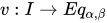


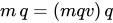


This means that and thus that equalizes , whence .

Second definition
[edit]In a category with all finite limits and colimits, the image is defined as the equalizer of the so-called cokernel pair , which is the cocartesian of a morphism with itself over its domain, which will result in a pair of morphisms , on which the equalizer is taken, i.e. the first of the following diagrams is cocartesian, and the second equalizing.[3]





Remarks:
- Finite bicompleteness of the category ensures that pushouts and equalizers exist.
- can be called regular image as is a regular monomorphism, i.e. the equalizer of a pair of morphisms. (Recall also that an equalizer is automatically a monomorphism).
- In an abelian category, the cokernel pair property can be written and the equalizer condition . Moreover, all monomorphisms are regular.


Theorem—If always factorizes through regular monomorphisms, then the two definitions coincide.
First definition implies the second: Assume that (1) holds with regular monomorphism.
- Equalization: one needs to show that . As the cokernel pair of and by previous proposition, since has all equalizers, the arrow in the factorization is an epimorphism, hence .
- Universality: in a category with all colimits (or at least all pushouts) itself admits a cokernel pair





- Moreover, as a regular monomorphism, is the equalizer of a pair of morphisms but we claim here that it is also the equalizer of .
- Indeed, by construction thus the "cokernel pair" diagram for yields a unique morphism such that . Now, a map which equalizes also satisfies , hence by the equalizer diagram for , there exists a unique map such that .
- Finally, use the cokernel pair diagram (of ) with : there exists a unique such that . Therefore, any map which equalizes also equalizes and thus uniquely factorizes as . This exactly means that is the equalizer of .













Second definition implies the first:
- Factorization: taking in the equalizer diagram ( corresponds to ), one obtains the factorization .
- Universality: let be a factorization with regular monomorphism, i.e. the equalizer of some pair .


- Then so that by the "cokernel pair" diagram (of ), with , there exists a unique such that .
- Now, from (m from the equalizer of (i1, i2) diagram), one obtains , hence by the universality in the (equalizer of (d1, d2) diagram, with f replaced by m), there exists a unique such that .






Examples
[edit]In the category of sets the image of a morphism is the inclusion from the ordinary image to . In many concrete categories such as groups, abelian groups and (left- or right) modules, the image of a morphism is the image of the correspondent morphism in the category of sets.


In any normal category with a zero object and kernels and cokernels for every morphism, the image of a morphism can be expressed as follows:
- im f = ker coker f
In an abelian category (which is in particular binormal), if f is a monomorphism then f = ker coker f, and so f = im f.
Essential Image
[edit]A related notion to image is essential image.[4]
A subcategory of a (strict) category is said to be replete if for every , and for every isomorphism , both and belong to C.


Let be a functor between categories. The essential image of is the smallest replete subcategory of the target category containing the image of under .


See also
[edit]References
[edit]- ↑ Mitchell, Barry (1965), Theory of categories, Pure and applied mathematics, vol. 17, Academic Press, ISBN 978-0-12-499250-4, MR 0202787 Section I.10 p.12
- ↑ Mitchell, Barry (1965), Theory of categories, Pure and applied mathematics, vol. 17, Academic Press, ISBN 978-0-12-499250-4, MR 0202787 Proposition 10.1 p.12
- ↑ Kashiwara, Masaki; Schapira, Pierre (2006), "Categories and Sheaves", Grundlehren der Mathematischen Wissenschaften, vol. 332, Berlin Heidelberg: Springer, pp. 113–114 Definition 5.1.1
- ↑ "essential image in nLab". ncatlab.org. Retrieved 2024-11-15.