


Hurricane Lowell
 Lowell near its second peak intensity south of Hawaii on September 5 | |
| Meteorological history | |
|---|---|
| Formed | August 27, 2026 |
| Post-tropical | September 11, 2026 |
| Dissipated | September 13, 2026 |
| Category 5 major hurricane | |
| 1-minute sustained (SSHWS/NWS) | |
| Highest winds | 160 mph (260 km/h) |
| Lowest pressure | 922 mbar (hPa); 27.23 inHg |
| Overall effects | |
| Fatalities | 3 direct |
| Damage | >$500 million (2026 USD) |
| Areas affected | Hawaiian Islands |
Part of the 2026 Pacific hurricane season | |
Hurricane Lowell was a long-lived and very powerful tropical cyclone that impacted the western Hawaiian Islands, making a direct hit on Ni'ihau and Kauaʻi. Lowell was the first hurricane to directly hit the island of Kauaʻi since Hurricane Iniki in 1992.[1][nb 1] The fourteenth named storm, fifth hurricane, fourth major hurricane, and second Category 5 hurricane of the 2026 Pacific hurricane season, Lowell formed on August 27 and reached Category 5 intensity on September 2. In doing so, it became the first Category 5 hurricane in the Central Pacific basin since Hurricane Walaka in 2018. Increasing wind shear and eyewall replacement cycles caused it to weaken to Category 3 status by September 4, but the following day, it rapidly intensified to Category 5 intensity once again. Increasing wind shear caused it to weaken to a Category 2 hurricane by the time it made its direct hit on Kaua'i County, and Lowell became post-tropical by September 11.
Lowell's powerful winds damaged structures and knocked out power for most Kaua'i County customers. Overall, the storm caused over $500 million of damage in Hawai'i and killed at least three.
Meteorological history
[edit]
Tropical storm (39–73 mph, 63–118 km/h)
Category 1 (74–95 mph, 119–153 km/h)
Category 2 (96–110 mph, 154–177 km/h)
Category 3 (111–129 mph, 178–208 km/h)
Category 4 (130–156 mph, 209–251 km/h)
Category 5 (≥157 mph, ≥252 km/h)
Unknown


 Extratropical cyclone, remnant low, tropical disturbance, or monsoon depression
On August 24, the National Hurricane Center (NHC) first noted a low potential for eventual tropical cyclogenesis, related to a trough located east-southeast of Hawaii. The weather system produced thunderstorms as it drifted northeastward across the eastern Pacific Ocean.[3] By August 25, the NHC assessed a high likelihood – 70% – for a tropical cyclone to form.[4] That day, a weak and small low-pressure area developed within the system.[5] On August 26, the low became more organized due to favorable environmental conditions.[6] Late on August 27, the NHC classified the system as Tropical Storm Lowell about 1,530 miles (2,460 km) east-southeast of Hawaii. The storm had a closed circulation, producing winds of 40 mph (65 km/h) alongside well-organized bands of convection.[7]
Upon its formation, Lowell was moving to the east-northeast over an area of warm ocean temperatures.[7] The storm gradually strengthened amid some northeasterly wind shear.[8] Lowell's circulation became exposed from the thunderstorms, and the storm became disorganized. Late on August 28, Lowell turned to the west, steered by a ridge to its north. Around that time, the NHC noted uncertainty in the storm's future, due to potential interaction with Tropical Storm Karina to its east.[9] On August 29, thunderstorms reformed over the circulation, although it continued to be affected by wind shear through the next day.[10] On August 31, the convection became better organized after the wind shear decreased. By that time, the NHC anticipated that Lowell would undergo rapid intensification.[11] On September 1, Lowell attained hurricane status about 575 miles (925 km) to the southeast of Hilo, Hawaii.[12]

Late on September 1, Lowell intensified into a major hurricane, or a Category 3 on the Saffir-Simpson scale. The hurricane had an eye surrounded by a ring of deep convection.[13] Late on September 2, Lowell strengthened further into a Category 5 hurricane, with maximum sustained winds of 160 mph (260 km/h) and a minimum pressure of 927 mbar (27.4 inHg). Around that time, it was located about 445 mi (715 km) south of Hilo.[14] Lowell became the first Category 5 hurricane in the Central Pacific since Hurricane Walaka in 2018.[15] After reaching peak intensity, Lowell weakened due to a combination of increased wind shear, dry air, and an eyewall replacement cycle.[16] On September 4, it briefly fell to Category 3 intensity due to another replacement cycle.[17] Later that day, the Hurricane Hunters observed that Lowell re-intensified into a high-end Category 4 hurricane as the eyewall replacement cycle was complete.[18] Hurricane Hunters then observed that Lowell regained Category 5 intensity a few hours later, with maximum sustained winds of 160 mph (260 km/h) and a minimum central pressure of 922 mbar (27.2 inHg).[19] This made it the first Pacific hurricane to attain Category 5 intensity more than once since Hurricane Ioke in 2006 and only the third Pacific hurricane to do so on record, along with Hurricane Emilia in 1994 and Ioke.[20]
Soon after attaining Category 5 status a second time, Lowell again weakened slightly as its eye become less defined, possibly due to wind shear and dry air. The hurricane slowed on September 5 after the ridge to its north began weakening.[21] This was partly due to an upper-level low, located north of Hawaii and moving to the southwest; the low caused Lowell to turn sharply northward.[22] As wind shear increased and sea surface temperatures decreased, Lowell weakened below major hurricane strength on September 7.[23] Around 09:00 UTC on September 8, the center of Lowell passed about 40 mi (64 km) west of Niʻihau.[24][25] High wind shear caused the hurricane to weaken quickly, as the center became exposed from the convection.[26] On September 9, Lowell dropped to tropical storm status. It turned back to the west due to a building ridge, where dry air continued to affect the storm.[27] On September 11, the NHC redesignated Lowell as a post-tropical cyclone, more than 24 hours since the storm produced thunderstorms near the center.[28]
Preparations
[edit]On September 6 (UTC), the NHC issued a hurricane watch for the eastern part of Papahānaumokuākea Marine National Monument and a tropical storm watch for Kauai County.[29] Līhuʻe Airport was shut down in preparation of the hurricane.[30] Later that day, the agency upgraded the watches to warnings.[31] A flood watch was also in effect for the main Hawaiian Islands through September 8, with heavy rainfall expected to cause flash flooding and mudslides, especially on Kauaʻi and parts of the Big Island.[32] Due to further eastward shifts in the forecast path of the storm, a hurricane watch was issued for Kauai County on September 7, 2026 (UTC) and further upgraded to a hurricane warning later that day.[33] A few hours later, still more eastward shifts in the track forecast prompted a tropical storm watch, then a tropical storm warning, for Oahu.[34] Early on September 8 (UTC), a tornado watch was issued for Kauai County and adjacent waters, the first tornado watch issued for the state of Hawaii on record.[35]
On September 3, Hawaii governor Josh Green issued a state of emergency due to the threat from Lowell and potentially Karina.[36] The state activated 129 Hawaii National Guard members while also sending six high-water vehicles to Kauai.[37] Two state parks were closed to campers due to the hurricane. Campers were notified to vacate the parks immediately on September 4.[38]
Impact
[edit]
Prior to the brunt of impacts from Lowell, Kauaʻi's only weather radar was knocked out.[39] The hurricane dropped heavy rainfall across Hawaii, peaking at 21.11 in (536 mm) in Kilohana on Kauaʻi. Wind gusts in the state peaked at 92 mph (148 km/h) at Puʻu Lua.[40] Sustained winds to 59 mph (95 km/h) and a gust of 79 mph (127 km/h) were recorded at the Līhuʻe Airport.[41] Powerful waves and storm surge moved into coastal areas such as Kekaha and Poʻipu, causing extensive damage to structures and roadways. In Kekaha, Kaumualiʻi Highway fronting Kekaha Beach was completely obstructed by rocks and road fragments.[42] Kauaʻi Island Utility Cooperative reported that strong winds from Lowell knocked out power to over 91% of Kaua'i County.[43] Power outages at the Waimea Wastewater Treatment Plant led to the spill of 20,000 gallons of wastewater.[44]

Near Baby Beach in Poʻipū, a home was swept off of its foundation and onto neighboring properties.[45][46] In Poʻipū, storm surge paired with high surf damaged parts of the Beach House Restaurant and the Sheraton Kauaʻi Resort, which were among those hit the hardest.[47][48][49][50][51] A house in Hanapēpē lost its roof as a result of strong winds.[52] Port Allen Boat Harbor was extensively damaged.[53] Storm surge and surf also contributed to the destruction of Waimea Pier.[54] Further west in Kekaha, multiple homes were damaged by hurricane-force winds and storm surge.[55] In the commercial area of Līhuʻe, Hokulei Village and Kukui Grove sustained minor damages to their properties.[56]
A 74-year-old man in Kaua‘i was killed by the storm surge related to Lowell.[57] A 59-year-old man was found dead in Wainiha.[58] On Oʻahu, a tree fell on a homeless man's tent, killing him inside.[59] Oahu recorded 21,000 power outages.[60]
On September 18, it was reported that 18 homes in Kaua’i had been destroyed, with at least a 100 sustaining major damage. More than 700 additional homes were damaged in the county.[61][62]
Aftermath
[edit]| Precipitation | Storm | Location | Ref. | ||
|---|---|---|---|---|---|
| Rank | mm | in | |||
| 1 | 1473 | 58.00 | Lane 2018 | Kahūnā Falls, Hawaii | [63] |
| 2 | 1321 | 52.00 | Hiki 1950 | Kanalohuluhulu Ranger Station | [64] |
| 3 | 1106 | 43.54 | Lala 2026 | Laupāhoehoe | [65] |
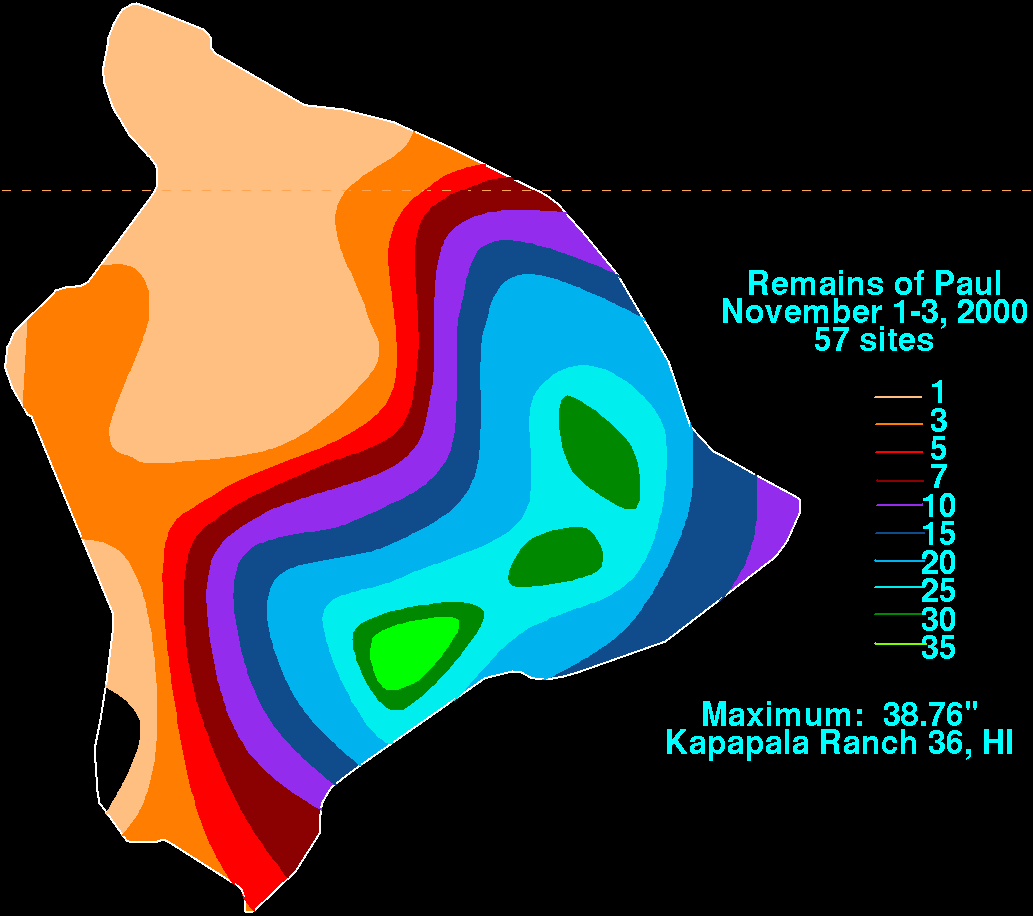
| 4 | 985 | 38.76 | Paul 2000 | Kapapala Ranch 36 | [66] |
| 5 | 732 | 28.82 | Hone 2024 | Volcano Island | [67] |
| 6 | 635 | 25.00 | Maggie 1970 | Various stations | [68] |
| 7 | 536 | 21.11 | Lowell 2026 | Kilohana | [69] |
| 8 | 519 | 20.42 | Nina 1957 | Wainiha | [70] |
| 9 | 516 | 20.33 | Iwa 1982 | Intake Wainiha 1086 | [71] |
| 10 | 476 | 18.75 | Fabio 1988 | Papaikou Mauka 140.1 | [71] |
On September 7, the Hawaiʻi State Department of Education cancelled school for Kauaʻi and Oʻahu in advance of the storm's approach. Due to the damage left on Kauaʻi, the department extended the closure of schools on the island until September 11.[72]
On September 8, the Līhuʻe Airport was reopened to travelers. HDOT advised that travelers should expect delays and allow extra time to check in and get through TSA. The following day, Hawaiian and Alaska Airlines issued a notice that 'longer than usual' lines at the airport were occurring.[73][74] The island's two major shopping centers, Kukui Grove and The Shops at Kukui'ula were closed due to power loss.[75][76]
In response to cleanup efforts by residents, the County of Kauaʻi reopened the Kekaha Landfill and transfer stations across the island.[77] Collection fees were waived temporarily.[78] A wastewater spill was reported at the Waimea Wastewater Treatment Plant.[79] In response to food and ice shortages caused by prolonged power outages, food distribution sites were set up in key points across the island.[80] Local businesses such as Meme's Farmstand and The Musubi Truck offered free food to the community.[81][82]
On September 9, Governor Josh Green reported that initial damage estimates indicate the storm will cost more than US$400 million, exceeding the damage from Hurricane Lala, which struck Hawaii a few weeks prior.[83][84] Governor Green also stated that early in the recovery process, Lowell seemed to have caused more damage than Hurricane Iniki in 1992, the costliest tropical cyclone to hit the State of Hawaiʻi to date, with early estimates placing the total damage cost between $500 million and $1 billion.[85][86][87]
See also
[edit]
- Weather of 2026
- Tropical cyclones in 2026
- List of Category 5 Pacific hurricanes
- List of Hawaii hurricanes
- March 2026 Hawaii floods — flooding earlier in 2026 that left more than $1 billion in damage
Notes
[edit]- ↑ The National Hurricane Center officially defines a direct hit as, for locations on the right-hand side of the track, when the cyclone passes within a distance equal to twice the radius of maximum wind.[2]
References
[edit]- ↑ Sanchez, Raymond (2026-09-06). "Kaua'i still without power amid devastation following rare direct hit of deadly Hurricane Lowell on Hawaii". FOX Weather. Fox Weather. Retrieved 2026-09-11.
- ↑ "Glossary of National Hurricane Center terms". National Hurricane Center. Archived from the original on February 16, 2021. Retrieved July 11, 2026.
- ↑
- Reinhart (August 24, 2026). "Tropical Weather Outlook" (TXT). National Hurricane Center. Archived from the original on September 7, 2026. Retrieved September 3, 2026.
- Hagen (August 24, 2026). "Tropical Weather Outlook" (TXT). National Hurricane Center. Retrieved September 3, 2026.
- ↑ Blake (August 25, 2026). "Tropical Weather Outlook" (TXT). National Hurricane Center. Archived from the original on September 6, 2026. Retrieved September 3, 2026.
- ↑ Cangialosi, John; Katz, Jeremy; Evans, Lori (August 25, 2026). "Tropical Weather Outlook" (TXT). National Hurricane Center. Archived from the original on September 6, 2026. Retrieved September 3, 2026.
- ↑ Evans; Zelinsky (August 26, 2026). "Tropical Weather Outlook" (TXT). National Hurricane Center. Archived from the original on September 6, 2026. Retrieved September 3, 2026.
- 1 2 Beven, Jack (August 27, 2026). "Tropical Storm Lowell Discussion Number 1". National Hurricane Center. Retrieved September 3, 2026.
- ↑ Cangialosi, John (August 28, 2026). "Tropical Storm Lowell Discussion Number 3". National Hurricane Center. Archived from the original on August 30, 2026. Retrieved September 3, 2026.
- ↑ Jack kìBeven (August 28, 2026). "Tropical Storm Lowell Discussion Number 5". National Hurricane Center. Retrieved September 3, 2026.
- ↑
- Beven, Jack (August 29, 2026). "Tropical Storm Lowell Discussion Number 8". National Hurricane Center. Retrieved September 3, 2026.
- Gibbs (August 30, 2026). "Tropical Storm Lowell Discussion Number 11". National Hurricane Center. Retrieved September 3, 2026.
- ↑ Hagen (August 31, 2026). "Tropical Storm Lowell Discussion Number 16". National Hurricane Center. Retrieved September 3, 2026.
- ↑ Hagen (August 31, 2026). "Hurricane Lowell Discussion Number 20". National Hurricane Center. Retrieved September 3, 2026.
- ↑ Kelly. "Hurricane Lowell Tropical Cyclone Update". National Hurricane Center. Archived from the original on September 2, 2026. Retrieved September 4, 2026.
- ↑
- Reinhart, Brad (September 2, 2026). "Hurricane Lowell Discussion Number 24". National Hurricane Center. Retrieved 2026-09-02.
- Reinhart, Brad (September 2, 2026). "Hurricane Lowell Advisory Number 24". National Hurricane Center. Retrieved 2026-09-04.
- ↑ Porter, Greg (2026-09-02). "Hurricane Lowell reaches Category 5 and is still intensifying; track shifts toward Hawaii". www.sfchronicle.com. Archived from the original on 2026-09-03. Retrieved 2026-09-02.
- ↑ Reinhart (September 3, 2026). "Hurricane Lowell Discussion Number 30". National Hurricane Center. Retrieved September 4, 2026.
- ↑ Cangialosi (September 4, 2026). "Hurricane Lowell Discussion Number 33". National Hurricane Center. Retrieved September 4, 2026.
- ↑ Cangialosi; Evans (September 4, 2026). "Hurricane Lowell Tropical Cyclone Update". National Hurricane Center. Retrieved September 4, 2026.
- ↑ Gibbs; Pierce (September 4, 2026). "Hurricane Lowell Discussion Number 36". National Hurricane Center. Retrieved September 4, 2026.
- ↑ Henson, Bob; Masters, Jeff (September 4, 2026). "How close to Hawaii will Hurricane Lowell get? » Yale Climate Connections". Yale Climate Connections. Archived from the original on September 5, 2026. Retrieved September 5, 2026.
- ↑
- Gibbs; Pierce (September 5, 2026). "Hurricane Lowell Discussion Number 37". National Hurricane Center. Retrieved September 5, 2026.
- Gibbs (September 5, 2026). "Hurricane Lowell Discussion Number 38". National Hurricane Center. Retrieved September 5, 2026.
- ↑
- Gibbs (September 6, 2026). "Hurricane Lowell Discussion Number 41". National Hurricane Center. Retrieved September 6, 2026.
- Robbie Berg (September 6, 2026). "Hurricane Lowell Discussion Number 42". National Hurricane Center. Retrieved September 6, 2026.
- ↑ "Hurricane Lowell Discussion Number 47". National Hurricane Center. September 7, 2026. Retrieved September 7, 2026.
- ↑ Reinhart (September 8, 2026). "Hurricane Lowell Discussion Number 49". National Hurricane Center. Retrieved September 8, 2026.
- ↑ Staff, Star-Advertiser (2026-09-07). "Powerful Hurricane Lowell passes 90 miles west of Līhuʻe". Honolulu Star-Advertiser. Archived from the original on 2026-09-08. Retrieved 2026-09-08.
- ↑
- Blake (September 8, 2026). "Hurricane Lowell Discussion Number 50". National Hurricane Center. Retrieved September 8, 2026.
- Blake (September 8, 2026). "Hurricane Lowell Discussion Number 51". National Hurricane Center. Retrieved September 8, 2026.
- ↑
- Adams (September 9, 2026). "Tropical Storm Lowell Discussion Number 52". National Hurricane Center. Retrieved September 9, 2026.
- Kelly (September 9, 2026). "Tropical Storm Lowell Discussion Number 55". National Hurricane Center. Retrieved September 9, 2026.
- Papin (September 10, 2026). "Tropical Storm Lowell Discussion Number 56". National Hurricane Center. Retrieved September 12, 2026.
- ↑ Papin (September 11, 2026). "Post-Tropical Cyclone Lowell Discussion Number 60". National Hurricane Center. Retrieved September 12, 2026.
- ↑ Gibbs, Alex (September 6, 2026). "Hurricane Lowell Public Advisory No. 40". National Hurricane Center. Retrieved September 6, 2026.
- ↑ "Lihue Airport reopens after Hurricane Lowell passes Kauai, port remains closed". 6 September 2026. Retrieved 9 September 2026.
- ↑ Berg, Robbie (September 6, 2026). "Hurricane Lowell Public Advisory No. 42". National Hurricane Center. Retrieved September 6, 2026.
- ↑ HPR News Staff (September 5, 2026). "Storm updates: Tropical Storm Warning issued for Kauaʻi as Hurricane Lowell approaches". Public Radio. Archived from the original on September 6, 2026. Retrieved September 6, 2026.
- ↑ "Hurricane Lowell Forecast Discussion Number 45". September 7, 2026. Retrieved September 7, 2026.
- ↑ "Hurricane Lowell Intermediate Advisory Number 46A". National Hurricane Center. September 7, 2026. Retrieved September 7, 2026.
- ↑ Talerico, Kate (2026-09-07). "Hawaii sees its first-ever tornado watch as Hurricane Lowell approaches". San Francisco Chronicle. Archived from the original on 2026-09-08. Retrieved 2026-09-08.
- ↑ "Office of the Governor – News Release – Gov. Green Declares State of Emergency, Pre-Positions Resources Ahead of Tropical Cyclones". Office of the Governor of Hawaii. September 3, 2026. Retrieved September 3, 2026.
- ↑ "Hurricane Lowell preparations on Kauai evoke memories of Iniki". Hawaii News Now. September 2, 2026. Archived from the original on September 3, 2026. Retrieved September 3, 2026.
- ↑ Mary Gilbert (September 5, 2026). "Hurricane Lowell remains powerful Category 4 as Hawaii braces for possible impacts". Cable News Network. Retrieved September 5, 2026.
- ↑ US Department of Commerce, NOAA. "Radar Free Text Messages for Hawaii". www.weather.gov. NOAA's National Weather Service. Archived from the original on 2026-08-13. Retrieved 2026-09-08.
- ↑ Oudit (September 9, 2026). "Storm Summary Number 3 for Heavy Rainfall and Wind Associated with Lowell". Weather Prediction Center. Archived from the original on January 13, 2026. Retrieved September 9, 2026.
- ↑ "Hurricane Lowell Advisory Number 49". www.nhc.noaa.gov. Retrieved 2026-09-08.
- ↑ "Instagram". www.instagram.com. Retrieved 2026-09-08.
- ↑ "91% of KIUC customers without power as Lowell moves north of Kaua'i, Ni'ihau | Kauai Now". | 91% of KIUC customers without power as Lowell moves north of Kaua‘i, Ni‘ihau. 2026-09-08. Archived from the original on 2026-09-09. Retrieved 2026-09-08.
- ↑ "Wastewater spill reported on Kauai after Hurricane Lowell". www.hawaiinewsnow.com. 2026-09-10. Retrieved 2026-09-10.
- ↑ "Hurricane Lowell lashes Hawaii, knocking out power to thousands as flood risk continues - CBS News". www.cbsnews.com. 2026-09-08. Retrieved 2026-09-11.
- ↑ Schenfeld, Nikki (September 8, 2026). "Poipu residents left reeling from Lowell's destruction". KHON2. Retrieved September 10, 2026.
- ↑ "Sheraton Kauai Resort among properties hit hardest by Hurricane Lowell storm surge". Pacific Business News. 2026-09-09. Retrieved 2026-09-11.
- ↑ "Instagram". www.instagram.com. Retrieved 2026-09-11.
- ↑ "Instagram". www.instagram.com. Retrieved 2026-09-08.
- ↑ "Instagram". www.instagram.com. Retrieved 2026-09-08.
- ↑ "Hurricane Lowell leaves trail of destruction across Kauai". NBC News. 2026-09-10. Retrieved 2026-09-11.
- ↑ Ancheta, Dillon; Staff, H. N. N. (2026-09-09). "'I was shaking': West Kauai residents ride out Hurricane Lowell, assess damage". www.hawaiinewsnow.com. Retrieved 2026-09-11.
- ↑ "Instagram". www.instagram.com. Retrieved 2026-09-08.
- ↑ 773K views · 8.7K reactions | Less than 24 hours difference. Waimea Pier has been reduced to concrete pillars and the park is flooded with water and downed tree limbs. #Waimea #Kauai #Hawaii #HurricaneLowell #WaimeaPier | Dillon Ancheta. Retrieved 2026-09-11 – via www.facebook.com.
- ↑ Shinigawa, Nathan (September 8, 2026). "Kekaha residents on Kauai assessing damages from Lowell". KHON2. Retrieved September 10, 2026.
- ↑ "Instagram". www.instagram.com. Retrieved 2026-09-11.
- ↑ "Missing 74-year-old Kauai man found dead after storm". Hawaii News Now. Retrieved 10 September 2026.
- ↑ Fujii-Oride, Noelle (2026-09-12). "Hurricane Lowell May Be To Blame For A Second Kaua'i Death". Honolulu Civil Beat. Retrieved 2026-09-12.
- ↑ Ory, Tyler; Gilbert, Mary; Waxman, Briana; Dolce, Chris; Petersen, Kate S.; Bragg, Julianna (September 6, 2026). "At least 1 killed in Hawaii after Hurricane Lowell devastates parts of the state, governor says". CNN. Retrieved September 9, 2026.
- ↑ "Hurricane Lowell causes power outages on Oahu". Hawaiian Electric. 8 September 2026. Retrieved 9 September 2026.
- ↑ "Sept. 18, 4:00 p.m., County of Kauaʻi, Hurricane Lowell Recovery". www.kauai.gov. Retrieved 2026-09-19.
- ↑ DeMasters, Tiffany (2026-09-12). "On anniversaries of devastating Hurricane ʻIniki and 9/11, Kauaʻi continues recovery from Lowell | Kauai Now". | On anniversaries of devastating Hurricane ʻIniki and 9/11, Kauaʻi continues recovery from Lowell. Retrieved 2026-09-12.
- ↑ David Roth (2019). "Hurricane Lane - August 22-27, 2018". Weather Prediction Center. Archived from the original on October 31, 2020. Retrieved July 24, 2019.
- ↑ Central Pacific Hurricane Center. Tropical Cyclones During the Years 1900-1952 (Report). United States National Oceanic and Atmospheric Administration's National Weather Service. Archived from the original on April 19, 2019. Retrieved January 26, 2007.
- ↑ Wilder, Hayden (August 17, 2026). "Storm Summary Number 3 for Heavy Rainfall and Wind Associated with Lala". www.wpc.ncep.noaa.gov. Weather Prediction Center. Retrieved August 17, 2026.
- ↑ Roth, David M.; Hydrometeorological Prediction Center. "Remains of Paul". Tropical Cyclone Point Maxima (GIF). United States National Oceanic and Atmospheric Administration's National Weather Service. Archived from the original on April 19, 2019. Retrieved December 28, 2007.
- ↑ Gibbs, Alex; Jelsema, Jon (December 10, 2025). Tropical Cyclone Report: Hurricane Hone (CP012025) (PDF) (Report). Miami, Florida: National Hurricane Center. Retrieved December 12, 2025.
- ↑ Central Pacific Hurricane Center. The 1970 Central Pacific Tropical Cyclone Season (PDF) (Report). United States National Oceanic and Atmospheric Administration's National Weather Service. Retrieved December 28, 2007.
- ↑ "Lowell PNS". National Weather Service. Retrieved September 10, 2026.
- ↑ Central Pacific Hurricane Center. The 1957 Central Pacific Tropical Cyclone Season (PDF) (Report). United States National Oceanic and Atmospheric Administration's National Weather Service. Retrieved November 28, 2007.
- 1 2 Roth, David M. (January 3, 2023). "Tropical Cyclone Point Maxima". Tropical Cyclone Rainfall Data. United States Weather Prediction Center. Retrieved January 6, 2023.
 This article incorporates text from this source, which is in the public domain.
 - ↑ "Kauaʻi County public schools to remain closed to students through Friday following Hurricane Lowell – Hawaiʻi State Department of Education". hawaiipublicschools.org. Retrieved 2026-09-11.
- ↑ KHON2 News (2026-09-09). 'Longer-than-usual' lines at Lihue Airport post-Lowell: Hawaiian Airlines. Retrieved 2026-09-11 – via YouTube.
{{cite AV media}}: CS1 maint: numeric names: authors list (link) - ↑ "Instagram". www.instagram.com. Retrieved 2026-09-11.
- ↑ "Instagram". www.instagram.com. Retrieved 2026-09-11.
- ↑ "Instagram". www.instagram.com. Retrieved 2026-09-11.
- ↑ "10:25 a.m., Sept. 9, County of Kauaʻi, Update". www.kauai.gov. Retrieved 2026-09-11.
- ↑ "Sept. 9, 5:50 p.m., UPDATE, County of Kauaʻi, Solid Waste Division". www.kauai.gov. Retrieved 2026-09-11.
- ↑ "Wastewater Spill at Waimea Wastewater Treatment Plant". www.kauai.gov. Retrieved 2026-09-11.
- ↑ "Food Distribution Sites to open on Kauaʻi following Hurricane Lowell". www.kauai.gov. Retrieved 2026-09-11.
- ↑ "Instagram". www.instagram.com. Retrieved 2026-09-11.
- ↑ "Instagram". www.instagram.com. Retrieved 2026-09-11.
- ↑ "Gov. Green warns Hurricane Lowell damage on Kauai will exceed $400M". Hawaii News Now. Retrieved 10 September 2026.
- ↑ Tyler Ory, Mary Gilbert, Briana Waxman, Chris Dolce, Kate S. Petersen, Julianna Bragg (2026-09-06). "At least 1 dead in Hawaii after Hurricane Lowell devastates parts of the state, governor says | CNN". CNN. Retrieved 2026-09-09.
{{cite news}}: CS1 maint: multiple names: authors list (link) - ↑ "Hurricane Lowell Estimated Damage to Hawaiian Islands Between $.5B and $1B: Cotality". Carrier Management. Retrieved 2026-09-16.
- ↑ "Office of the Governor – News Release – Gov. Green Requests Expedited Major Disaster Declaration Following Hurricane Lowell". governor.hawaii.gov. Retrieved 2026-09-11.
- ↑ "1992 Hurricane Iniki – State of Hawaiʻi Department of Defense". dod.hawaii.gov. Retrieved 2026-09-11.
External links
[edit]
- The NHC's Hurricane Lowell Advisory Archive
| 1950s | |
|---|---|
| 1970s | |
| 1990s | |
| 2000s | |
| 2010s | |
| 2020s | |



Tropical cyclones of the 2026 Pacific hurricane season | ||
|---|---|---|
 | ||