Hippomane
| Hippomane | |
|---|---|
.jpg) | |
| Hippomane mancinella | |
Scientific classification  | |
| Kingdom: | Plantae |
| Clade: | Tracheophytes |
| Clade: | Angiosperms |
| Clade: | Eudicots |
| Clade: | Rosids |
| Order: | Malpighiales |
| Family: | Euphorbiaceae |
| Subfamily: | Euphorbioideae |
| Tribe: | Hippomaneae |
| Subtribe: | Hippomaninae |
| Genus: | Hippomane L. |
| Type species | |
| Hippomane mancinella | |
| Synonyms[3] | |
| |
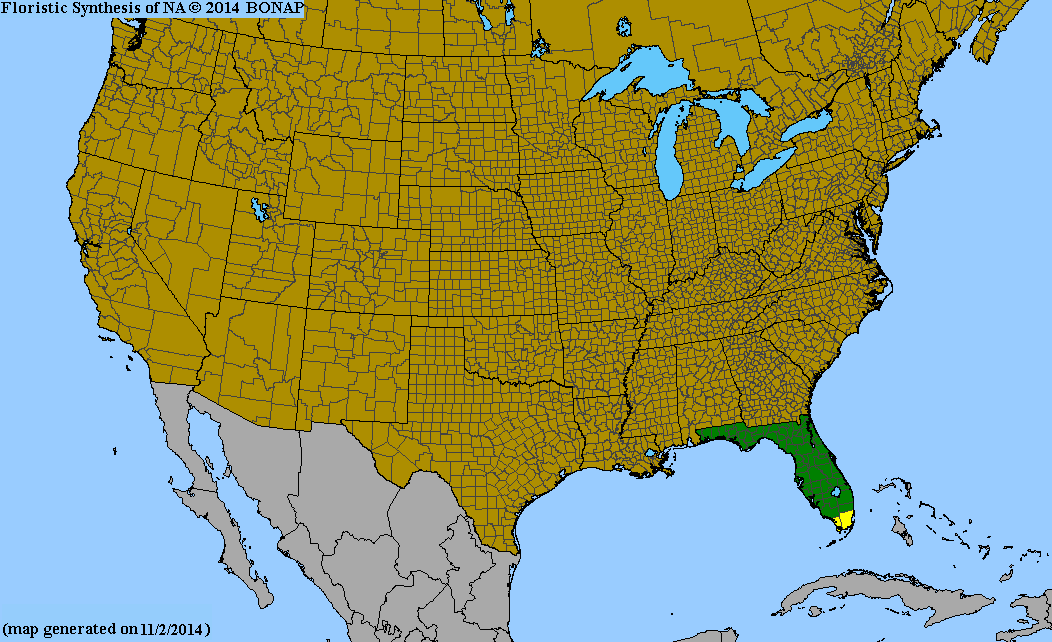
Hippomane is a genus of plants in the Euphorbiaceae described by Linnaeus in 1753.[2][4] It is native to the West Indies, Central America, Mexico, Florida, Venezuela, Colombia, and Galápagos.[3][5][6][7][8][9]
Derivation of name
[edit]The name of the genus references the Greek name hippomanes (applied by Theophrastus to an unidentified plant said to poison horses, sending them mad) - this being a compound of the Greek elements ἵππος (= (h)ippos) horse and μανία (= mania) insanity / frenzy - hence "sending horses insane".[10]
Species
[edit]- Accepted Species[3]
- Hippomane horrida Urb. & Ekman. - Barahona in Dominican Rep
- Hippomane mancinella L. - West Indies, Mexico, Central America, Florida Keys, Venezuela, Colombia, Galápagos
- Hippomane spinosa L. - Hispaniola
- Species formerly included[3]
moved to other genera: Sapium
References
[edit]- ↑ lectotype designated by M. L. Green, Prop. Brit. Bot. 195 (1929)
- 1 2 Tropicos, Hippomane L.
- 1 2 3 4 Kew World Checklist of Selected Plant Families
- ↑ Linnaeus, Carl von. 1753. Species Plantarum 2: 1191-1192 in Latin
- ↑ Govaerts, R., Frodin, D.G. & Radcliffe-Smith, A. (2000). World Checklist and Bibliography of Euphorbiaceae (and Pandaceae) 1-4: 1-1622. The Board of Trustees of the Royal Botanic Gardens, Kew.
- ↑ González Ramírez, J. 2010. Euphorbiaceae. En: Manual de Plantas de Costa Rica. Vol. 5. B.E. Hammel, M.H. Grayum, C. Herrera & N. Zamora (eds.). Monographs in systematic botany from the Missouri Botanical Garden 119: 290–394.
- ↑ Martínez Gordillo, M., J. J. Ramírez, R. C. Durán, E. J. Arriaga, R. García, A. Cervantes & R. M. Hernández. 2002. Los géneros de la familia Euphorbiaceae en México. Anales del Instituto de Biología de la Universidad Nacional Autónoma de México, Botánica 73(2): 155–281.
- ↑ Webster, G. L. & M.J. Huft. 1988. Revised synopsis of Panamanian Euphorbiaceae. Annals of the Missouri Botanical Garden 75(3): 1087–1144.
- ↑ Biota of North America Program 2013 county distribution map
- ↑ Quattrocchi, Umberto (2012). CRC World dictionary of medicinal and poisonous plants: common names, scientific names, eponyms, synonyms and etymology. CRC Press Taylor and Francis Group. ISBN 978-1-4398-9445-3 Volume III E-L pps. 484-5.
| National | |
|---|---|
| Other | |