


Hausdorff density
In measure theory, a field of mathematics, the Hausdorff density measures how concentrated a Radon measure is at some point.
Definition
[edit]Let be a Radon measure and some point in Euclidean space. The s-dimensional upper and lower Hausdorff densities are defined to be, respectively,


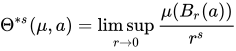
and
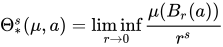
where is the ball of radius r > 0 centered at a. Clearly, for all . In the event that the two are equal, we call their common value the s-density of at a and denote it .



Marstrand's theorem
[edit]The following theorem states that the times when the s-density exists are rather seldom.
- Marstrand's theorem: Let be a Radon measure on . Suppose that the s-density exists and is positive and finite for a in a set of positive measure. Then s is an integer.

Preiss' theorem
[edit]In 1987 David Preiss proved a stronger version of Marstrand's theorem. One consequence is that sets with positive and finite density are rectifiable sets.
- Preiss' theorem: Let be a Radon measure on . Suppose that m is an integer and the m-density exists and is positive and finite for almost every a in the support of . Then is m-rectifiable, i.e. ( is absolutely continuous with respect to Hausdorff measure ) and the support of is an m-rectifiable set.


External links
[edit]References
[edit]- Pertti Mattila, Geometry of sets and measures in Euclidean spaces. Cambridge Press, 1995.
- Preiss, David (1987). "Geometry of measures in : distribution, rectifiability, and densities". Ann. Math. 125 (3): 537–643. doi:10.2307/1971410. hdl:10338.dmlcz/133417. JSTOR 1971410.
