


Hasse derivative
 | This article relies on a single source. (May 2024) |
In mathematics, the Hasse derivative is a generalisation of the derivative which allows the formulation of Taylor's theorem in coordinate rings of algebraic varieties.
Definition
[edit]Let k[X] be a polynomial ring over a field k. The r-th Hasse derivative of Xn is
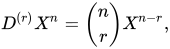
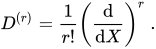
if n ≥ r and zero otherwise.[1] In characteristic zero we have
Properties
[edit]The Hasse derivative is a generalized derivation on k[X] and extends to a generalized derivation on the function field k(X),[1] satisfying an analogue of the product rule
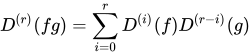
and an analogue of the chain rule.[2] Note that the are not themselves derivations in general, but are closely related.

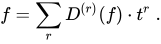
A form of Taylor's theorem holds for a function f defined in terms of a local parameter t on an algebraic variety:[3]
Notes
[edit]References
[edit]- Goldschmidt, David M. (2003). Algebraic functions and projective curves. Graduate Texts in Mathematics. Vol. 215. New York, NY: Springer-Verlag. ISBN 0-387-95432-5. Zbl 1034.14011.
 | This algebra-related article is a stub. You can help Wikipedia by adding missing information. |