


Grassmann graph
| Grassmann graph | |
|---|---|
| Named after | Hermann Grassmann |
| Vertices | |
| Edges | |
| Diameter | min(k, n − k) |
| Properties | Distance-transitive Connected |
| Notation | Jq(n,k) |
| Table of graphs and parameters | |

![{\displaystyle {\frac {q[k]_{q}[n-k]_{q}}{2}}{\binom {n}{k}}_{q}}](https://wikimedia.org/api/rest_v1/media/math/render/svg/453131d1cbc3c106d79353e94ed26db5af93a5ad)
In graph theory, Grassmann graphs are a special class of simple graphs defined from systems of subspaces. The vertices of the Grassmann graph Jq(n, k) are the k-dimensional subspaces of an n-dimensional vector space over a finite field of order q; two vertices are adjacent when their intersection is (k − 1)-dimensional.
Many of the parameters of Grassmann graphs are q-analogs of the parameters of Johnson graphs, and Grassmann graphs have several of the same graph properties as Johnson graphs.
Graph-theoretic properties
[edit]- Jq(n, k) is isomorphic to Jq(n, n − k).
- For all 0 ≤ d ≤ diam(Jq(n,k)), the intersection of any pair of vertices at distance d is (k − d)-dimensional.
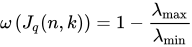
- The clique number of Jq(n,k) is given by an expression in terms its least and greatest eigenvalues λ min and λ max:
Automorphism group
[edit]There is a distance-transitive subgroup of isomorphic to the projective linear group .[citation needed]
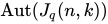

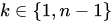
In fact, unless or , ; otherwise or respectively.[1]



![{\displaystyle \operatorname {Aut} (J_{q}(n,k))\cong \operatorname {Sym} ([n]_{q})}](https://wikimedia.org/api/rest_v1/media/math/render/svg/28c02950d46777cc245a7bd54e7ca44a9aefbaae)
Intersection array
[edit]As a consequence of being distance-transitive, is also distance-regular. Letting denote its diameter, the intersection array of is given by where:



- for all .
- for all .
![{\displaystyle b_{j}:=q^{2j+1}[k-j]_{q}[n-k-j]_{q}}](https://wikimedia.org/api/rest_v1/media/math/render/svg/160106de756c2b37438a25c749cf52207078b9f2)

![{\displaystyle c_{j}:=([j]_{q})^{2}}](https://wikimedia.org/api/rest_v1/media/math/render/svg/60e4982914de043107f5c842183a0e53a8eb7ca8)

Spectrum
[edit]- The characteristic polynomial of is given by
- .[1]
![{\displaystyle \varphi (x):=\prod \limits _{j=0}^{\operatorname {diam} (J_{q}(n,k))}\left(x-\left(q^{j+1}[k-j]_{q}[n-k-j]_{q}-[j]_{q}\right)\right)^{\left({\binom {n}{j}}_{q}-{\binom {n}{j-1}}_{q}\right)}}](https://wikimedia.org/api/rest_v1/media/math/render/svg/b920a1e55f769c2b97fad0d3d11f7a5e0b24735e)