


Gaussian year

A Gaussian year is defined as 365.2568983 days.[1] It was adopted by Carl Friedrich Gauss as the length of the sidereal year in his studies of the dynamics of the Solar System. A slightly different value is now accepted as the length of the sidereal year,[2] and the value accepted by Gauss is given a special name.
A particle of negligible mass, that orbits a body of 1 solar mass in this period, has a mean axis for its orbit of 1 astronomical unit by definition. The value is derived from Kepler's third law as
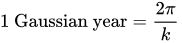
where
- k is the Gaussian gravitational constant.[3]
See also
[edit]References
[edit]- ↑ Gauss, Carl Friedrich; Davis, Charles Henry (1857). Theory of the Motion of the Heavenly Bodies Moving about the Sun in Conic Sections. Boston: Little, Brown and Company. p. 2.
- ↑ Chamberlin, Alan. "Astrodynamic Constants". ssd.jpl.nasa.gov. Retrieved 2016-11-16.
- ↑ Herrick, S.; Baker, R. M. L. Jr.; Hilton, C. G. (1958-01-01). "Gravitational and Related Constants for Accurate Space Navigation". In Hecht, F. (ed.). VIIIth International Astronautical Congress Barcelona 1957 / VIII. Internationaler Astronautischer Kongress / VIIIe Congrès International d'Astronautique. Springer Berlin Heidelberg. pp. 197–235. doi:10.1007/978-3-662-39990-3_17. ISBN 978-3-662-39020-7.
{{cite book}}: CS1 maint: ignored ISBN errors (link)
 | This astronomy-related article is a stub. You can help Wikipedia by adding missing information. |