


Euthrix potatoria
| Euthrix potatoria | |
|---|---|
 | |
| Male | |
 | |
| Female | |
Scientific classification  | |
| Kingdom: | Animalia |
| Phylum: | Arthropoda |
| Clade: | Pancrustacea |
| Class: | Insecta |
| Order: | Lepidoptera |
| Family: | Lasiocampidae |
| Genus: | Euthrix |
| Species: | E. potatoria |
| Binomial name | |
| Euthrix potatoria | |
| Synonyms | |
| |
_-_Keila.jpg)
Euthrix potatoria, the drinker, is an orange-brown moth of the family Lasiocampidae.[1]
The species' common and scientific names derive from the larva's supposed drinking of drops of dew.[2]
Name
[edit]The scientific name Euthryx potatoria was given to this moth by Carl Linnaeus in 1758. In choosing the name potatoria 'drinker-like', he was inspired by the Dutch entomologist Johannes Goedaert, who had called the animal dronckaerdt 'drunkard' "because it is very much inclined to drinking".[3] This remark refers to the moth's habit of repeatedly plunging its head into the water.[4] The English name drinker (moth) also refers to Goedaert's analogy.
Subspecies
[edit]Subspecies include:[1]
- Euthrix potatoria mikado Bryk
- Euthrix potatoria potatoria (Linnaeus, 1758)
Distribution and habitat
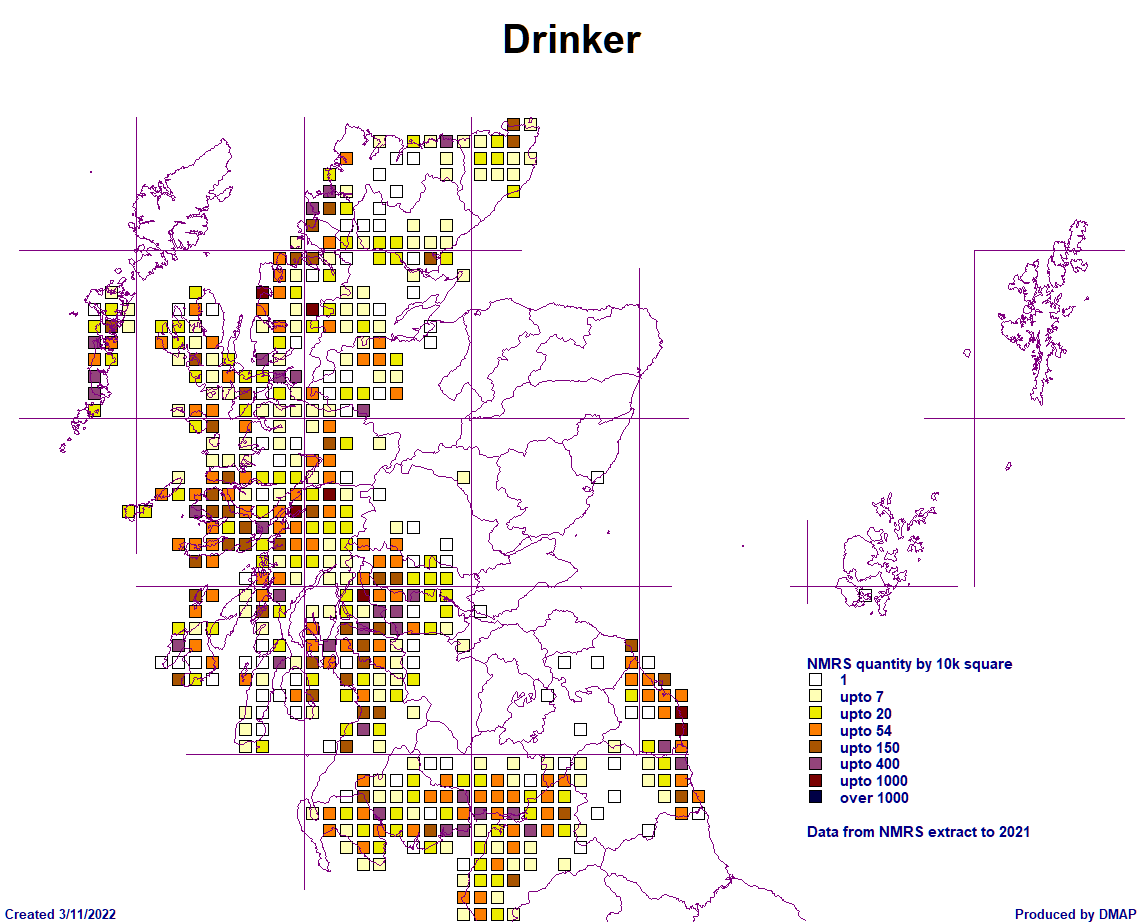
[edit]This species can be found in Europe.[5] The species is fairly common in the southern half of Britain.[citation needed] In Scotland, it is common in the west but not in the east of the country.[6] It is most frequently found in marshy places, fens and riversides but may also be seen in drier, grassy terrain.[7][2]
Description
[edit]Imago
[edit]The imago has a wingspan of 4.5–6.5 cm (1.8–2.6 in). The yellowish females are slightly larger than the orange-brown male but both sexes usually show the two distinctive white spots on the forewing.[2] Females have slightly serrated antennae, while male have deeply combed antennae.[8]
Larvae and pupae
[edit]The fully grown larva is about 6 cm (2.4 in) long, hairy, striped and spotted, with distinctive tufts fore and aft. Larvae hibernate while young and resume feeding in the spring, pupating in a cocoon during the summer.[7]
Biology
[edit]This nocturnal moth flies from June to August depending on the location. Males especially are attracted to light.[7][2] The females lay their eggs in small clusters, mainly on the stem of grasses or reeds.[8] The larvae feed on various grasses and reeds (Alopecurus, Deschampsia, Dactylis, Elymus (syn. Elytrigia), Carex, Luzula and other Gramineae).[9]
Gallery
[edit] Drinker moth caterpillar eating grass.
 Caterpillar
 Caterpillar (ventral)
 Mounted specimen. Male
 Female

_-_Keila.jpg)


References
[edit]- 1 2 "Euthrix potatoria (Drinker)". BioLib. Retrieved 2025-05-27.
- 1 2 3 4 "The Drinker". UKmoths. Ian Kimber. Retrieved 2025-05-27.
- ↑ Goedaert, Johannem (1662). Metamorphosis naturalis (in Dutch). Middelburgh: Jaques Fierens. p. 47. doi:10.5962/bhl.title.15828. Archived from the original on 2014-05-30. Retrieved 2025-05-27 – via Biodiversity Heritage Library.
Ick heb hem den dronckaerdt ghenaempt om dat hy feer tot het drincken genegen was. [I called him the "drunkard" because he was very fond of drinking.]
- ↑ Beelen, Hans; van der Sijs, Nicoline (2018). "Natneus, molenaar, hypocriet. Insectennamen uit de zeventiende eeuw" [Wet nose, miller, hypocrite. Insect names from the seventeenth century.] (PDF). Onze Taal (in Dutch) (7/8). The Hague: Genootschap Onze Taal: 26–27. Retrieved 2025-05-27.
- ↑ "Euthrix potatoria (Linnaeus 1758) - Taxon Details". faunaeur.org. Berlin: Fauna Europaea. 2013-08-29. Archived from the original on 2016-03-04. Retrieved 2025-05-27.
- ↑ "Scottish Moth Flight Times and Distribution Maps - East Scotland branch". eastscotland-butterflies.org.uk. Wareham, Dorset: Butterfly Conservation. 2022-11-03. Code 66.010 (1640). Retrieved 2025-05-27.
- 1 2 3 Ford, R.L.E. (1974). The Observer's Book of Larger Moths. London: Frederick Warne & Co. Ltd. p. 223. ISBN 0723215340. Retrieved 2025-05-27.
- 1 2 "The Drinker moth (Euthrix potatoria)". Wildlife Insight. Falmouth, UK: Claire & Steve Ogden. 2015-03-28. Retrieved 2025-05-27.
- ↑ Mazzei, Paolo; Morel, Daniel; Panfili, Raniero. "Euthrix potatoria (Linnaeus, 1758)". Moths and Butterflies of Europe and North Africa. Rome. Retrieved 2025-05-27.
External links
[edit]