


Elliptic gamma function
In mathematics, the elliptic gamma function is a generalization of the q-gamma function, which is itself the q-analog of the ordinary gamma function. It is closely related to a function studied by Jackson (1905), and can be expressed in terms of the triple gamma function. It is given by

It obeys several identities:
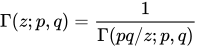

and

where θ is the q-theta function.
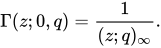
When , it essentially reduces to the infinite q-Pochhammer symbol:

Multiplication Formula
[edit]Define

Then the following formula holds with (Felder & Varchenko (2002)).


References
[edit]- Felder, G.; Varchenko, A. (2002). "Multiplication Formulas for the Elliptic Gamma Function". arXiv:math/0212155.
- Jackson, F. H. (1905), "The Basic Gamma-Function and the Elliptic Functions", Proceedings of the Royal Society of London. Series A, Containing Papers of a Mathematical and Physical Character, 76 (508), The Royal Society: 127–144, Bibcode:1905RSPSA..76..127J, doi:10.1098/rspa.1905.0011, ISSN 0950-1207, JSTOR 92601
- Gasper, George; Rahman, Mizan (2004), Basic hypergeometric series, Encyclopedia of Mathematics and its Applications, vol. 96 (2nd ed.), Cambridge University Press, ISBN 978-0-521-83357-8, MR 2128719
- Ruijsenaars, S. N. M. (1997), "First order analytic difference equations and integrable quantum systems", Journal of Mathematical Physics, 38 (2): 1069–1146, Bibcode:1997JMP....38.1069R, doi:10.1063/1.531809, ISSN 0022-2488, MR 1434226
- Felder, Giovanni; Henriques, André; Rossi, Carlo A.; Zhu, Chenchang (2008). "A gerbe for the elliptic gamma function". Duke Mathematical Journal. 141. arXiv:math/0601337. doi:10.1215/S0012-7094-08-14111-0. S2CID 817920.