


Elaeodendron orientale
| Elaeodendron orientale | |
|---|---|
 | |
| Young Elaeodendron orientale tree on Réunion island | |
Scientific classification  | |
| Kingdom: | Plantae |
| Clade: | Embryophytes |
| Clade: | Tracheophytes |
| Clade: | Angiosperms |
| Clade: | Eudicots |
| Clade: | Rosids |
| Order: | Celastrales |
| Family: | Celastraceae |
| Genus: | Elaeodendron |
| Species: | E. orientale |
| Binomial name | |
| Elaeodendron orientale | |
| Synonyms[1] | |
| |
Elaeodendron orientale, known locally as bois d'olive, is a tall canopy tree endemic to the Mascarene Islands of Mauritius, Réunion, and Rodrigues.[1]
Juveniles have shiny narrow leaves with a bright red mid-rib and smooth edges; while adult leaves are wide and oval with a serrated margin.
In its native islands the tree has been severely over-exploited for its valuable reddish wood. Adults reach up to 20 meters in height. The fruits resemble small olives, from which the local name derives.[2]
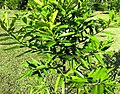 Foliage of a young tree
 Foliage of an adult


References
[edit]
Wikimedia Commons has media related to Elaeodendron orientale.
- 1 2 "Elaeodendron orientale Jacq". Plants of the World Online. Royal Botanic Gardens, Kew. Retrieved 1 April 2026.
- ↑ "Cassine orientalis". arbres-reunion.cirad.fr. Archived from the original on 2008-10-19.
 | This Celastraceae article is a stub. You can help Wikipedia by adding missing information. |