


Dual wavelet
 | This article needs more citations. (October 2010) |
In mathematics, a dual wavelet is the dual to a wavelet. In general, the wavelet series generated by a square-integrable function will have a dual series, in the sense of the Riesz representation theorem. However, the dual series is not itself in general representable by a square-integrable function.
Definition
[edit]Given a square-integrable function , define the series by



for integers .

Such a function is called an R-function if the linear span of is dense in , and if there exist positive constants A, B with such that



for all bi-infinite square summable series . Here, denotes the square-sum norm:


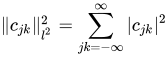
and denotes the usual norm on :

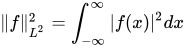
By the Riesz representation theorem, there exists a unique dual basis such that


where is the Kronecker delta and is the usual inner product on . Indeed, there exists a unique series representation for a square-integrable function f expressed in this basis:


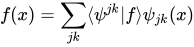
If there exists a function such that


then is called the dual wavelet or the wavelet dual to ψ. In general, for some given R-function ψ, the dual will not exist. In the special case of , the wavelet is said to be an orthogonal wavelet.


An example of an R-function without a dual is easy to construct. Let be an orthogonal wavelet. Then define for some complex number z. It is straightforward to show that this ψ does not have a wavelet dual.


See also
[edit]References
[edit]- Charles K. Chui, An Introduction to Wavelets (Wavelet Analysis & Its Applications), (1992), Academic Press, San Diego, ISBN 0-12-174584-8