


Draft:Cartier-Kostant Theorem
 | Review waiting, please be patient.
This may take 5 weeks or more, since drafts are reviewed in no specific order. There are 2,564 pending submissions waiting for review.
Where to get help
How to improve a draft
You can also browse Wikipedia:Featured articles and Wikipedia:Good articles to find examples of Wikipedia's best writing on topics similar to your proposed article. Improving your odds of a speedy review To improve your odds of a faster review, tag your draft with relevant WikiProject tags using the button below. This will let reviewers know a new draft has been submitted in their area of interest. For instance, if you wrote about a female astronomer, you would want to add the Biography, Astronomy, and Women scientists tags. Editor resources
Reviewer tools
|
The Cartier–Kostant theorem (also called the Cartier–Gabriel–Kostant theorem) is a structure theorem for cocommutative Hopf algebras over fields of characteristic zero.[1]
Let be a cocommutative Hopf algebra over an algebraically closed field of characteristic zero. Let


be its group of group-like elements, and let

be its Lie algebra of primitive elements. Then
![{\displaystyle H\cong U(P(H))\#k[G(H)],}](https://wikimedia.org/api/rest_v1/media/math/render/svg/9f628b1c6ac90962064498da7250c9fb636016f3)
where is the universal enveloping algebra of , is the group algebra of , and is the smash product induced by the conjugation action


![{\displaystyle k[G(H)]}](https://wikimedia.org/api/rest_v1/media/math/render/svg/561f14ec9a5c3f3808cc6721042c46a4a46c429a)


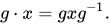
Thus a cocommutative Hopf algebra in characteristic zero is described by its primitive elements, its group-like elements, and the action of the latter on the former.
When is connected, is trivial and

which is the connected case associated with the Milnor–Moore theorem.[2]
Morally, this says that cocommutative Hopf algebras over fields of characteristic zero are classified by only three pieces of datum alone: a Lie algebra, a group, and some twisting information (more specifically, a group action on the Lie algebra).
See also
[edit]References
[edit]- 1 2 Kalisnik, J.; Mrcun, J. (2010-12-29). "A Cartier-Gabriel-Kostant structure theorem for Hopf algebroids". arXiv.org. Retrieved 2026-09-25.
- ↑ Milnor, John W.; Moore, John C. (1965). "On the structure of Hopf algebras". Annals of Mathematics. 81 (2): 211–264. doi:10.2307/1970615.
 | This algebra-related article is a stub. You can help Wikipedia by adding missing information. |