


Dittert conjecture
The Dittert conjecture, or Dittert–Hajek conjecture, is a mathematical hypothesis in combinatorics concerning the maximum achieved by a particular function of matrices with real, nonnegative entries satisfying a summation condition. The conjecture is due to Eric Dittert and (independently) Bruce Hajek.[1][2][3][4]

Let be a square matrix of order with nonnegative entries and with . Its permanent is defined as where the sum extends over all elements of the symmetric group.
![{\displaystyle A=[a_{ij}]}](https://wikimedia.org/api/rest_v1/media/math/render/svg/a1abea4bedfb4eabb36df6d0c0b97aebc10829fb)

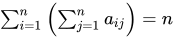
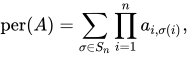

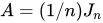
The Dittert conjecture asserts that the function defined by is (uniquely) maximized when , where is defined to be the square matrix of order with all entries equal to 1.[1][2]



References
[edit]- 1 2 Hogben, Leslie, ed. (2014). Handbook of Linear Algebra (2nd ed.). CRC Press. pp. 43–8. ISBN 978-1-4665-0729-6.
- 1 2 Cheon, Gi-Sang; Wanless, Ian M. (15 February 2012). "Some results towards the Dittert conjecture on permanents". Linear Algebra and Its Applications. 436 (4): 791–801. doi:10.1016/j.laa.2010.08.041. hdl:1885/28596.
- ↑ Eric R. Dittert at the Mathematics Genealogy Project
- ↑ Bruce Edward Hajek at the Mathematics Genealogy Project
.svg) | This combinatorics-related article is a stub. You can help Wikipedia by adding missing information. |