


Disphenocingulum
| Disphenocingulum | |
|---|---|
 | |
| Type | Johnson J89 – J90 – J91 |
| Faces | 20 triangles 4 squares |
| Edges | 38 |
| Vertices | 16 |
| Vertex configuration | 4(32.42) 4(35) 8(34.4) |
| Symmetry group | D2d |
| Properties | convex, elementary |
| Net | |
 | |

In geometry, the disphenocingulum is a Johnson solid with 20 equilateral triangles and 4 squares as its faces.
Properties
[edit]The disphenocingulum is named by Johnson (1966). The prefix dispheno- refers to two wedgelike complexes, each formed by two adjacent lunes—a figure of two equilateral triangles at the opposite sides of a square. The suffix -cingulum, literally 'belt', refers to a band of 12 triangles joining the two wedges.[1] The resulting polyhedron has 20 equilateral triangles and 4 squares, making 24 faces.[2]. All of the faces are regular, categorizing the disphenocingulum as a Johnson solid—a convex polyhedron in which all of its faces are regular polygon—enumerated as 90th Johnson solid .[3]. It is an elementary polyhedron, meaning that it cannot be separated by a plane into two small regular-faced polyhedra.[4]

The surface area of a disphenocingulum with edge length can be determined by adding all of its faces, the area of 20 equilateral triangles and 4 squares , and its volume is .[2]


Cartesian coordinates
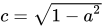
[edit]Let be the second smallest positive root of the polynomial and and . Then, the Cartesian coordinates of a disphenocingulum with edge length 2 are given by the union of the orbits of the points under the action of the group generated by reflections about the xz-plane and the yz-plane.[5]




References
[edit]- ↑ Johnson, N. W. (1966). "Convex polyhedra with regular faces". Canadian Journal of Mathematics. 18: 169–200. doi:10.4153/cjm-1966-021-8. MR 0185507. S2CID 122006114. Zbl 0132.14603.
- 1 2 Berman, M. (1971). "Regular-faced convex polyhedra". Journal of the Franklin Institute. 291 (5): 329–352. doi:10.1016/0016-0032(71)90071-8. MR 0290245.
- ↑ Francis, D. (August 2013). "Johnson solids & their acronyms". Word Ways. 46 (3): 177.
- ↑ Cromwell, P. R. (1997). Polyhedra. Cambridge University Press. p. 86–87, 89. ISBN 978-0-521-66405-9.
- ↑ Timofeenko, A. V. (2009). "The non-Platonic and non-Archimedean noncomposite polyhedra". Journal of Mathematical Science. 162 (5): 717. doi:10.1007/s10958-009-9655-0. S2CID 120114341.
External links
[edit]- Weisstein, Eric W., "Disphenocingulum" ("Johnson solid") at MathWorld.